
If you run a factory in India, electricity is almost certainly your largest operating expense, often accounting for 15–40% of total production costs. And with industrial tariffs rising year on year and DISCOM penalty clauses growing stricter, the pressure to reduce electricity costs in manufacturing plants has never been greater.
The good news? Most Indian manufacturing plants are losing energy through preventable inefficiencies: poor power factor, uncorrected harmonics, inefficient motors, and no solar integration. Address these, and savings of 20–35% on your monthly electricity bill are not just possible, they are achievable for energy intensive plants across Maharashtra, Gujarat, Karnataka, and beyond.
This guide walks you through 9 proven strategies to reduce electricity bill in manufacturing plants in India, with proven data and actionable steps you can start this week.
To reduce electricity bill in a manufacturing plant in India:
- Fix low power factor to avoid DISCOM penalties;
- Install Active Harmonic Filters to cut harmonic losses;
- Conduct a professional Energy Audit to identify waste;
- Shift loads to off-peak ToD tariff slots;
- Upgrade to energy efficient motors (IE3/IE4);
- Install solar PV with BESS for daytime load;
- Use Variable Frequency Drives (VFDs) on pumps and fans;
- Implement a Power Quality Audit to detect sags and surges;
- Automate demand control to stay within contracted maximum demand.
Why Electricity Bills Are So High in Indian Manufacturing Plants
Before fixing the problem, it helps to understand what drives high industrial electricity costs in India. Your monthly electricity bill is made up of several components, and most plants focus on just one.
| Bill Component | Typical Contribution | Your Control Level |
| Energy Charges (kWh) | 50–60% of total bill | HIGH reduce via efficiency & solar |
| Maximum Demand (kVA) | 20–30% of total bill | HIGH reduce via demand control |
| Power Factor Penalty | 5–15% extra surcharge | VERY HIGH fix with PF correction |
| Harmonic Losses | Hidden: 3–8% energy waste | MEDIUM requires AHF / Power Quality Audit |
The Electricity (Amendment) Bill 2025 is also bringing significant tariff reforms for Indian manufacturers including the phased removal of cross-subsidies within five years. This means the window to lock in cost reductions is now. Plants that optimise their power infrastructure today will be far better positioned as market tariffs normalise.
9 Proven Ways to Reduce Electricity Bill in Manufacturing Plants in India
1. Fix Power Factor to Eliminate DISCOM Penalties
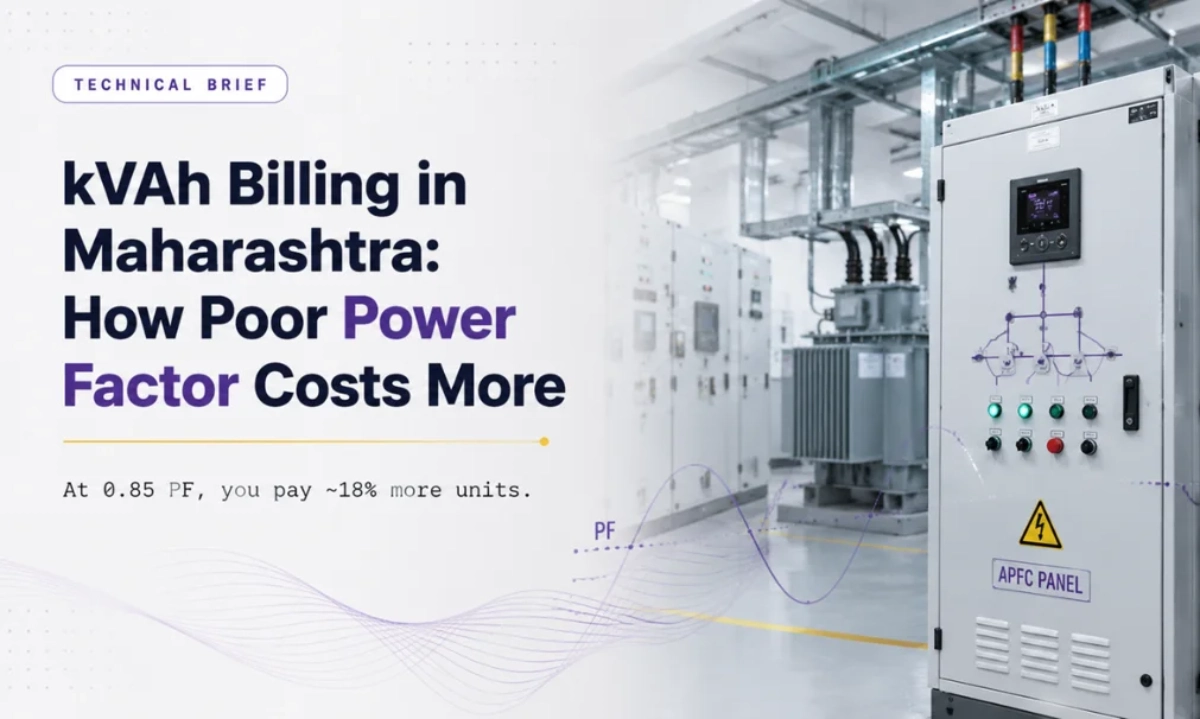
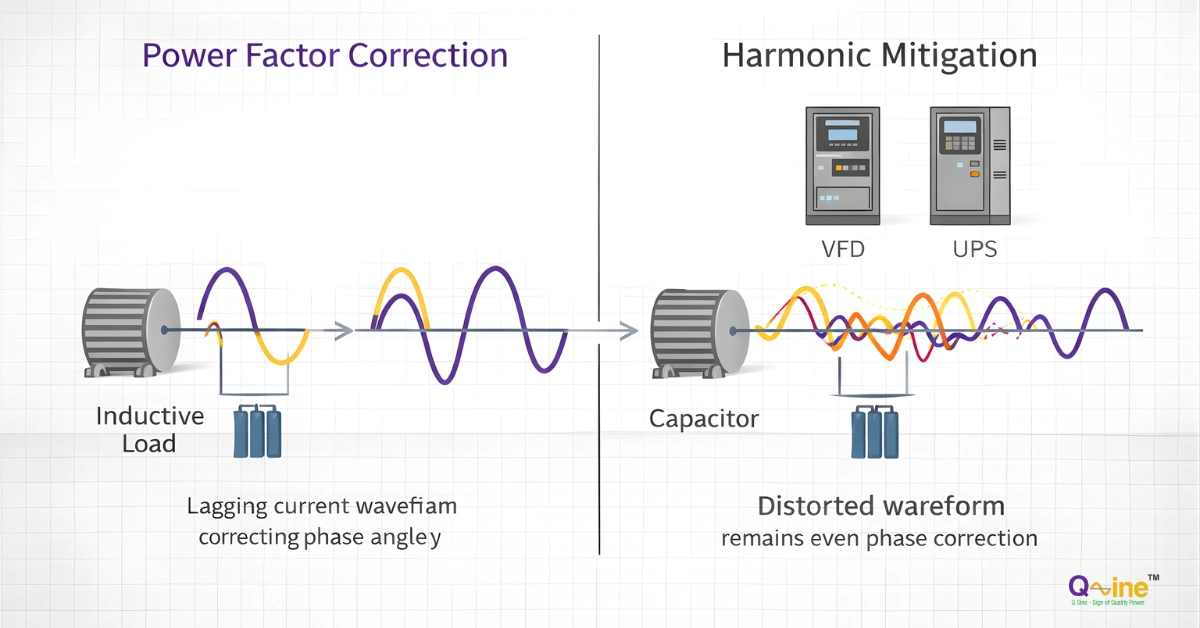
Power Factor (PF) is the ratio of useful (active) power to total drawn power. Most Indian DISCOMs penalise factories with a PF below 0.90, and in Maharashtra, MSEDCL imposes surcharges of up to 2% per 0.01 unit drop below the benchmark. This can silently add lakhs to your annual electricity bill.
Conversely, maintaining a PF above 0.95 attracts rebates in many states, effectively paying you to be efficient.
What causes low power factor in manufacturing plants?
- VFDs (Variable Frequency Drives) on motors
- Induction motors running at partial load
- Welding machines and arc furnaces
- UPS systems and rectifiers
How to fix it:
- APFC Panels (Automatic Power Factor Correction): step based capacitor switching for stable loads
- Static Var Generators (SVG) / RTPFC Panels for dynamic, rapidly varying loads. Responds in <20ms vs APFC’s 200ms+
- Hybrid Filter Panels Combined PF correction + harmonic filtering in a single solution
Real World Result
Q Sine installed an SVG-based RTPFC panel at a leading pharmaceutical manufacturing unit in Pune. Power factor improved from 0.97 to 0.995, eliminating penalty charges and qualifying the plant for MSEDCL rebates within 6 months.
2. Eliminate Harmonic Losses with Active Harmonic Filters
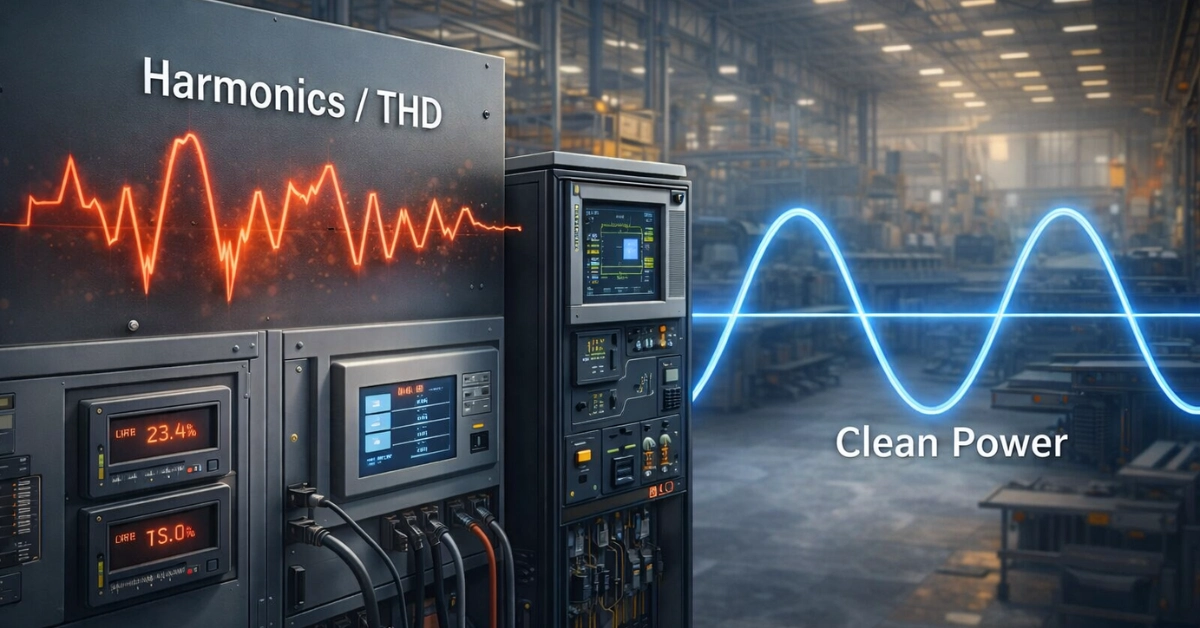
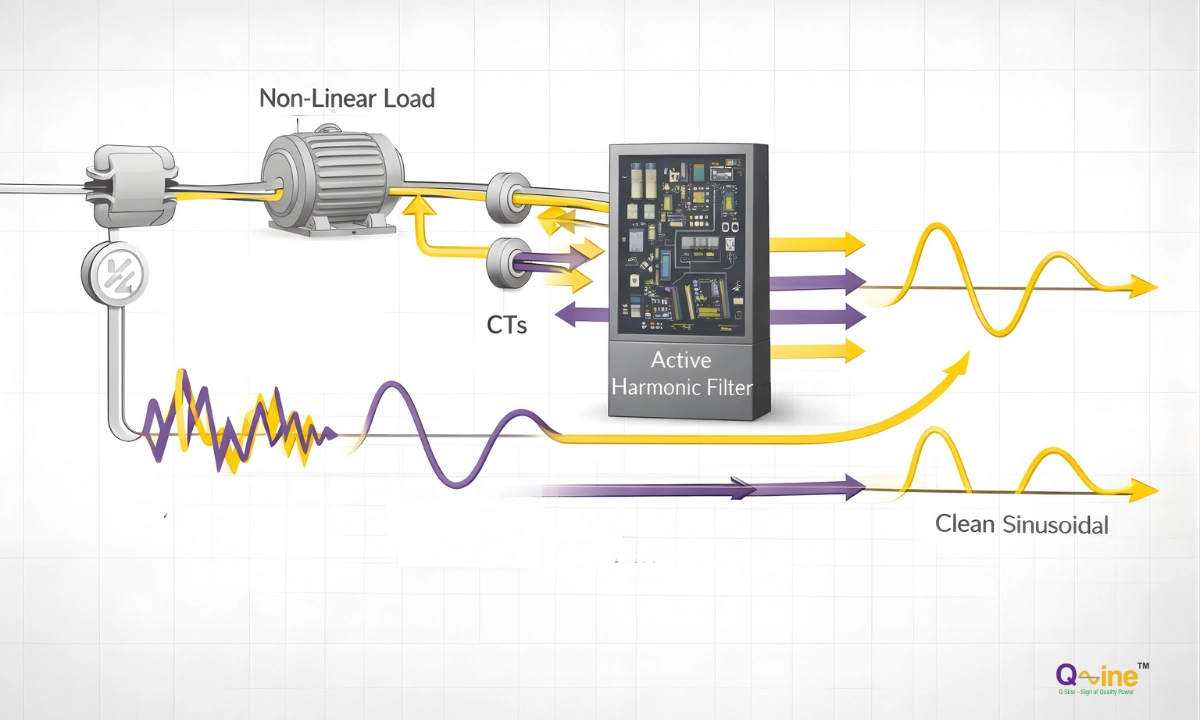
Harmonics are distorted waveforms caused by nonlinear loads primarily VFDs, inverters, LED drivers, and rectifiers. They are invisible on standard energy meters but cause real losses: transformers run hotter, cables carry excess current, and capacitor banks fail prematurely.
A plant with Total Harmonic Distortion (THD) above 8% is typically wasting 3–8% of its consumed energy to harmonic currents. This is energy that shows up on your bill but does no productive work.
Active Harmonic Filters (AHF) inject counter harmonics in real time, reducing THD to below 5% the IEEE 519:2014 compliance target. The result is not just energy savings but longer equipment life and fewer breakdowns.
Real World Result
At a large spinning mill in Bhopal, Q Sine deployed 2,550 A of AHF capacity. Current THD dropped from 15% to below 7%, meeting IEEE 519:2014. Transformer cooling loads also reduced, contributing to measurable energy savings.
3. Conduct a Professional Energy Audit
A factory energy audit is the most cost effective first step any plant can take. It maps every energy consumption point, quantifies losses, and produces a prioritised list of savings opportunities with ROI timelines.
In India, the Bureau of Energy Efficiency (BEE) mandates energy audits for Designated Consumers (DCs) under the Energy Conservation Act. But even non-DCs benefit enormously from voluntary audits.
What a professional energy audit covers:
- Power quality measurements (voltage, current, THD, PF)
- Maximum demand analysis and demand charge optimisation
- Motor efficiency and loading analysis
- Compressed air system losses
- Lighting system efficiency
- Transformer loading and losses
- Cooling and HVAC system efficiency
Q Sine’s Energy Audit service typically identifies 15% to 25% savings potential in the first assessment, with payback periods of 12–36 months on recommended investments.
4. Leverage Time-of-Day (ToD) Tariffs
Most Indian state DISCOMs offer Time-of-Day (ToD) tariff structures where electricity costs less during off-peak hours (typically 10 PM to 6 AM) and more during peak hours (6 AM to 10 PM, or as defined by SERC).
Maharashtra’s MSEDCL offers ToD incentives where off-peak rates are significantly lower. Industries that shift non-critical loads (grinding, batch mixing, water pumping, cold storage cooling) to night shifts can save 10–15% on energy charges with zero capital investment.
Practical ToD optimisation checklist:
- Map all deferrable loads in your plant
- Review your state DISCOM’s current ToD schedule
- Schedule batch processes to off-peak windows
- Use Automatic Demand Controllers to prevent peak demand spikes
- Monitor monthly to verify savings
5. Upgrade to IE3 / IE4 Energy Efficient Motors
Electric motors consume over 60–70% of a manufacturing plant’s total electricity in India. Yet the majority of installed motors in Indian factories are still IE1 (standard efficiency) or IE2 class, which are 3–7% less efficient than IE3 / IE4 motors.
India’s BEE energy labelling programme and the 2023 mandate for IE2+ motors above 37 kW means motor replacement is no longer optional for large plants it is a compliance requirement. Even below mandatory thresholds, the ROI on motor replacement is typically 24 years based on 8,000 operating hours per year at ₹7–9 per kWh.
Motor Efficiency Example
A 55 kW IE1 motor running 6,000 hours/year at ₹8/unit costs approximately ₹2.7 lakh annually. Upgrading to an IE3 equivalent (94.5% vs 91% efficiency) saves approximately 3.5% energy, or ₹9,400 per motor per year. For a plant with 50 such motors, that is ₹4.7 lakh saved every year.
6. Install Solar PV + BESS to Cut Grid Dependency
Rooftop and ground mounted solar installations are now the single fastest growing energy cost reduction strategy for Indian manufacturers. With solar tariffs in India below ₹2.5–3.5 per kWh (versus grid rates of ₹7–11 per kWh for HT consumers), the arithmetic is compelling.
Pairing solar with a Battery Energy Storage System (BESS) extends the benefit beyond daylight hours, enabling plants to store surplus solar energy and discharge it during peak tariff windows, or provide backup power during grid outages.
Solar + BESS ROI for Indian manufacturers (indicative):
| Parameter | Solar Only | Solar + BESS |
| Grid Hours Replaced | 6–8 hrs (day only) | Up to 16–20 hrs |
| Typical Payback (India) | 3–5 years | 5–7 years |
| Bill Reduction | 20–30% | 35–55% |
7. Install VFDs on Pumps, Fans, and Compressors
Pumps, fans, and air compressors are the most over-motorised assets in Indian manufacturing plants. Most run at fixed speed even when the process requires only 60–70% of rated flow wasting the excess energy as heat or throttling losses.
Variable Frequency Drives (VFDs) solve this by continuously matching motor speed to actual demand. The energy savings follow the cube law of affinity: reducing a pump from 100% speed to 80% cuts energy consumption to just 51% of the original, a 49% saving on that motor’s running cost.
Typical VFD payback in Indian factories is 12–24 months on pumps and cooling tower fans, one of the best ROIs available in industrial energy management.
8. Control Maximum Demand with Demand Controllers
Maximum Demand (MD) charges are based on your peak consumption in any 30-minute block during the billing period (15 minutes for some DISCOMs). Many plants unknowingly trigger high MD by starting several large motors simultaneously or running full capacity operations briefly at shift start.
Automatic Demand Controllers (ADC) monitor real-time load and shed non-critical loads automatically when demand approaches the contracted MD threshold. This prevents the single high peak event that drives up your entire month’s demand charge. Savings of up to 20% on demand charges are common.
9. Implement a Regular Power Quality Audit
A Power Quality Audit (PQA) is the diagnostic backbone of any serious electricity cost reduction programme. It uses precision instruments to record voltage fluctuations, current harmonics, power factor profiles, and demand patterns over 7–30 days.
Without this data, energy saving investments are made blindly. With it, every rupee of capex is directed to the highest impact solution first.
- For harmonic heavy plants: PQA identifies THD levels to right size AHF installations
- For penalty prone plants: PQA maps PF profiles through the day to size APFC/SVG correctly
- For demand charge concerns: PQA reveals the specific loads and times that drive your peak MD
Q Sine’s Power Quality Audit service includes a detailed report with solution recommendations and payback analysis giving plant managers a complete roadmap to reduce electricity costs.
Expected Savings Summary: At a Glance
| Strategy | Est. Savings | Typical Payback | Priority |
| Power Factor Correction (APFC/SVG) | 5–15% | 12–24 months | 🔴 Critical |
| Active Harmonic Filters (AHF) | 3–8% | 18–30 months | 🔴 Critical |
| Energy Audit | 15–25% identified | Immediate ROI data | 🔴 Start Here |
| ToD Tariff Shifting | 10–15% | 0–3 months | 🟡 Easy Win |
| Motor Upgrades (IE3/IE4) | 3–7% per motor | 24–48 months | 🟡 Medium |
| Solar + BESS | 20–55% | 3–7 years | 🟢 Strategic |
| VFDs on Pumps/Fans | 20–50% on motor | 12–24 months | 🔴 High ROI |
| Demand Controllers | Up to 20% MD charge | 6–18 months | 🟡 Medium |
| Power Quality Audit | Enables all above | Self funding | 🔴 Foundation |
Where to Start: The Q Sine 3 Step Approach
Every manufacturing plant is different. But our experience with hundreds of industrial clients across India from sugar mills in Maharashtra to textile plants in Gujarat, and the finding is consistent: the right starting point always pays for everything that follows.
| Step 1 | Book a Free Power Quality Consultation Q Sine’s engineers review your last 12 months of electricity bills and identify your biggest cost drivers in a free 30-minute consultation. |
| Step 2 | OnSite Power Quality Audit (7–30 Days) Our certified energy auditors install power quality analysers across your HT/LT panels to capture real data: THD, PF profiles, demand peaks, voltage events. |
| Step 3 | Prioritised Solutions with Guaranteed ROI You receive a prioritised roadmap from quick wins like ToD scheduling to capital investments like AHF or solar + BESS, with payback calculations for each, so your finance team can approve with confidence. |
Conclusion
Reducing electricity bills in Indian manufacturing plants is not a single intervention. It is a layered energy strategy. Begin with measurement (Power Quality Audit), fix the hidden losses (PF correction + harmonic mitigation), optimise your tariff usage (ToD scheduling + demand control), and build towards energy independence (solar + BESS).
Q Sine has helped over 200 manufacturing plants across India from pharma and automotive to textiles and agro processing, with sustained energy savings of 20–35% on electricity costs. Our turnkey approach means one partner handles assessment, solution design, supply, installation, and annual maintenance.
Frequently Asked Questions
How much can a manufacturing plant realistically save on its electricity bill in India?
Most Indian manufacturing plants can save 15–35% on their total electricity bill by combining power factor correction, harmonic mitigation, motor upgrades, and ToD optimisation. Plants that also add solar PV + BESS can achieve 40–55% reduction in grid dependency. Actual savings depend on your current baseline, installed load type, and state DISCOM tariff structure.
What is the first step to reduce electricity costs in my factory?
Start with a Power Quality Audit. Without measurement data, any investment is a guess. A 7–30 day PQA maps your actual power factor profile, harmonic levels, demand peaks, and voltage events. This gives you a prioritized savings roadmap with ROI for each fix. Q Sine offers free initial consultations to help you understand your bill composition.
What is a power factor penalty in India and how do I avoid it?
Indian DISCOMs impose a power factor penalty surcharge when your plant’s monthly average PF falls below the benchmark (typically 0.90 in Maharashtra under MSEDCL). The surcharge can be 1–2% of the bill for every 0.01 drop below target. Installing an APFC panel or Static Var Generator (SVG) automatically maintains PF above 0.95, eliminating penalties and often qualifying for rebates.
Is solar energy cost effective for industrial manufacturing plants in India?
Yes, industrial solar ROI in India is among the best in the world. With grid HT tariffs at ₹7–11/kWh and solar generation costs at ₹2.5–3.5/kWh, the savings per unit are substantial. A 500 kWp rooftop system can save ₹40–60 lakh annually. Pairing with BESS extends operation into peak tariff hours, improving payback further. Net metering policies in most states allow export credits too.
What are harmonics and why do they increase my electricity bill?
Harmonics are distorted voltage/current waveforms caused by nonlinear loads like VFDs, UPS systems, and rectifiers. They don’t show up clearly on your electricity meter but cause real energy waste: transformers overheat and draw extra reactive power, cables carry excess current, and capacitor banks fail early (increasing capex). Active Harmonic Filters (AHF) remove harmonics in real time, typically recovering 3–8% of wasted energy.
How long does it take to see ROI on energy saving investments in a manufacturing plant?
ROI timelines vary by solution: ToD shifting and demand control give returns within 1–6 months. VFDs on pumps and fans typically pay back in 12–24 months. APFC / SVG panels pay back in 12–24 months. Active Harmonic Filters in 18–30 months. Solar PV in 3–5 years. BESS in 5–7 years. An energy audit pays for itself by identifying quick wins that fund further investments.
Continue Reading
Get free access to this article and stay updated with Q Sine's latest insights on power quality and energy solutions. No spam, ever.
You're in!
Unlocking the full article now…
Your details are safe. We never share or sell your data.