
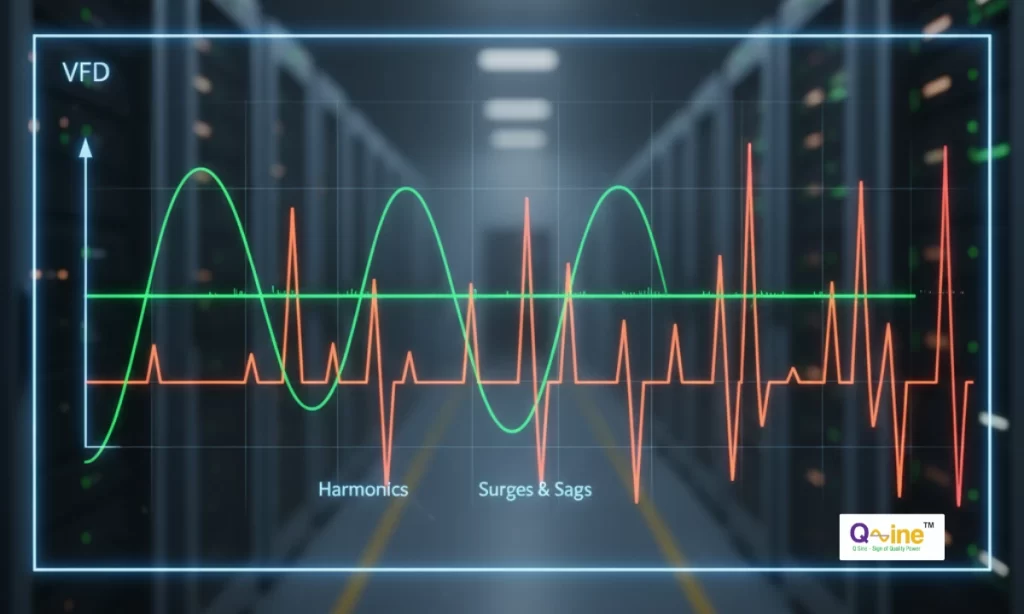
Modern industrial operations rely entirely on a stable, predictable flow of electricity. A perfect power supply is a pure, noise-free sinusoidal waveform, consistently maintained within strict voltage and frequency tolerances. For sophisticated Indian manufacturing plants, adherence to this standard is critical. However, today’s facilities use complex, high-efficiency technologies—from Variable Frequency Drives (VFDs) to automated controllers—that are highly sensitive to power quality (PQ) disturbances.
These disturbances—Harmonics, Voltage Sags, and Voltage Surges—act as invisible system killers. They are brief but inflict cumulative damage, shorten equipment life, and can halt production without warning. Understanding these three common power quality issues is the first step toward protecting industrial machinery and ensuring long-term profitability. This requires focusing on clean power, not just availability.
1. Harmonics: The Distortion That Causes Overheating
What is Harmonic Distortion?
Harmonics are electrical “noise” or distortion introduced onto the fundamental electrical waveform. If the standard Alternating Current (AC) supply (which runs at 50 Hz in India) is a clean musical note, Harmonics are unwanted, higher-frequency vibrations (multiples like 150 Hz, 250 Hz, and so on) that ride along, resulting in a jagged, unhealthy flow of electricity.
The Root Cause: Non-Linear Loads
Harmonics are generated by modern industrial equipment known as non-linear loads. These devices draw current in quick, non-uniform pulses, creating the harmful distortion. Ironically, some technologies installed for energy efficiency are major contributors. Primary culprits include:
- Variable Frequency Drives (VFDs): Widely used in pumps and HVAC systems, VFDs are a significant source of harmonic distortion.
- Uninterruptible Power Supplies (UPS): Essential for backup, these systems also generate harmonics .
- Office Equipment: Devices like computers and LED lighting systems with switch-mode power supplies also contribute.
If non-linear loads exceed 15% of the total load, the system often faces significant negative harmonic distortions .
Impact on Business Operations
This electrical “noise” translates directly into irreversible physical and operational damage. Harmonic currents increase copper and iron losses, leading to extreme overheating of vital components like transformers and motors. This thermal stress degrades insulation materials, shortens equipment operational life, and lowers machine efficiency.
Beyond physical damage, Harmonics introduce peak currents that interfere with sensitive control systems. This results in spurious alarms on VFDs, computer lock-ups, PLC errors, and unexpected tripping of MCBs or blown fuses . This cumulative damage reverses expected energy savings, creating hidden, long-term operational costs.
2. Voltage Sags (Dips): The Biggest Cause of Costly Downtime
Understanding a Voltage Sag
A Voltage Sag, or dip, is a sudden, short-term reduction in the electrical voltage, typically dropping 10% or more below the nominal supply level. A sag is a brief event lasting anywhere from half a cycle to several seconds, not a prolonged reduction like a brownout.
Common Causes in the Indian Grid
Sags pose the greatest immediate threat to operational continuity. They are frequently caused by external events, such as short-circuit faults or ground faults in the transmission or distribution lines (due to weather, animals, or collisions).
Internal causes are also prevalent. Sags commonly occur during network switching or when large, heavy electrical machinery is started, drawing significant instantaneous current (high inrush loads).
Impact: Why Sags Are So Expensive
The primary consequence of a sag is immediate, critical operational downtime. When voltage drops below the threshold, sensitive industrial control equipment—PLCs, data processing hardware, and VFD controls—malfunction or reboot, halting production.
Furthermore, when input voltage drops severely, equipment power supply units (PSUs) draw more current to maintain output power, resulting in a considerable amperage spike to connected loads. This stress damages internal components quickly. Data shows that voltage sags and micro-interruptions are the largest contributor to power quality related costs, accounting for over 60% of total losses, which can represent up to 4% of a company’s annual turnover due to unexpected outages and data loss.
3. Voltage Surges (Spikes): Accelerating Equipment Failure
Understanding a Voltage Surge
A Voltage Surge is the opposite of a sag: a sharp, sudden increase in voltage, typically 10% or more above the nominal level. Though often brief, high surge voltages are immediately destructive.10
Causes and Effects
Surges can originate externally from natural events like lightning strikes or internally from routine operations, such as switching off heavy inductive loads.
The most dangerous aspect is cumulative damage. Repeated surge events accelerate the wear and tear on sensitive electronics. These transients degrade the integrity of insulation and critical semiconductor components found within inverters, transformers, and control panels. This accelerated deterioration shortens the Mean Time Between Failures (MTBF) for expensive assets, leading to premature replacement and high, unpredictable maintenance costs.
The Cost of Inaction: Why Diagnosis is Critical
Power quality issues are rarely isolated; they compound the stress on the system. Ignoring these problems results in inefficient energy use, recurring maintenance expenses, and severe production disruption. The table below summarizes the key identifiers for these silent killers of industrial efficiency.
Quick Comparison of Common Industrial Power Quality Issues
| Issue | Simple Definition | Typical Industrial Cause | Primary Business Impact |
| Harmonics | Distortion of the ideal electrical wave (adding “noise”). | Variable Frequency Drives (VFDs), UPS Systems, LED Lighting. | Overheating of motors/transformers, reduced equipment lifespan, tripping of circuit breakers. |
| Voltage Sag (Dip) | A short, sudden drop in voltage (10% or more). | Starting heavy motors; External grid faults/short circuits. | Immediate equipment reboot or failure, production line stoppage, data loss. |
| Voltage Surge (Spike) | A short, sharp increase in voltage (10% or more). | Switching off heavy inductive loads; Electrical transients. | Permanent damage to sensitive electronic components, accelerated component wear and tear. |
Solving the Power Quality Puzzle: The Q Sine Power Quality Audit
Before any solution can be effective, the exact nature and origin of the power quality deficiency must be identified. This is where a professional diagnostic assessment is critical.
A comprehensive Power Quality Audit (PQA) provides the essential data required for concrete solutions. Q Sine specialists utilize advanced monitoring tools to measure and quantify these disturbances over an extended period. The audit specifically analyzes incoming power, grounding integrity, and system parameters, including voltage and current harmonics up to the 50th order, Power Factor, and transient activity.
This detailed analysis pinpoints whether the issues are generated internally by non-linear loads or are external factors originating from the utility grid.
Based on PQA findings, tailored Energy Saving and Clean Power solutions are implemented. Since industrial power quality is often a multi-faceted challenge involving harmonics, reactive power, and voltage instability, modern, integrated technologies are essential.
Solutions often include dynamic devices such as Active Harmonic Filters, which actively compensate for harmonic currents and reactive power while regulating voltage fluctuations simultaneously. Proactively managing power quality through a data-driven PQA reduces unexpected downtime, significantly extends the lifespan of expensive machinery, and ensures that the facility operates efficiently, reliably, and profitably.