
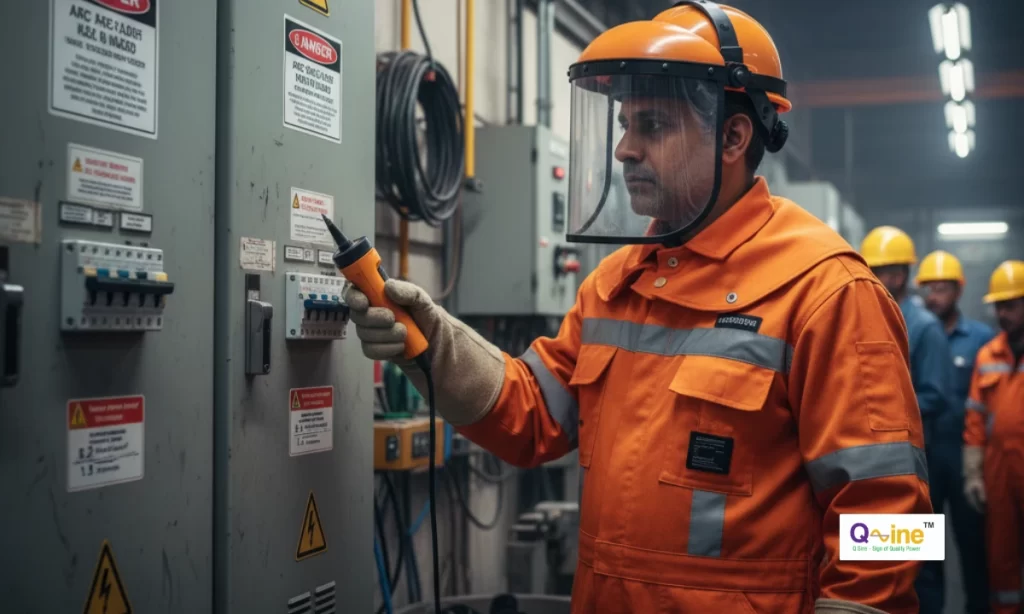
In any industrial or commercial facility, electricity is the silent workhorse that powers progress. However, this essential resource carries inherent risks, with arc flash being one of the most severe. An arc flash is a sudden, explosive release of energy caused by an electrical fault, capable of causing catastrophic injuries, equipment damage, and significant operational downtime. For facility owners and managers in India, ensuring electrical safety isn’t just a best practice—it’s a fundamental legal and ethical responsibility.
While India has its own set of electrical safety regulations, global standards like the National Fire Protection Association (NFPA) 70E and the Occupational Safety and Health Administration (OSHA) regulations provide a comprehensive framework that is widely recognised as the benchmark for workplace safety. Understanding how to navigate these standards is crucial for creating a truly safe working environment.
Why Global Standards Matter in India
India’s primary regulation for electrical safety is the Central Electricity Authority (CEA) Regulations, 2010 (Measures relating to Safety and Electric Supply). These regulations lay down the essential rules for electrical installations and worker safety. However, they are often principle-based, meaning they state what needs to be done but not always how to do it in detail.
This is where international standards like NFPA 70E become invaluable. NFPA 70E is not a law in India, but it is considered a globally accepted standard of care. It provides a detailed, practical roadmap for implementing a robust electrical safety program. Indian courts and regulatory bodies often refer to such international standards to determine if a company has taken all reasonable steps to protect its workers. In essence, aligning with NFPA 70E and OSHA principles is the clearest way to demonstrate due diligence and a commitment to safety.
Core Pillars of Arc Flash Compliance: A Blend of Indian and Global Standards
Achieving compliance is not about ticking boxes; it’s about building a culture of safety. Here’s how facility owners can integrate these global standards into their operations to meet and exceed Indian requirements.
1. Arc Flash Risk Assessment
The very first step, mandated by both NFPA 70E and implied by CEA regulations, is to conduct a thorough Arc Flash Risk Assessment. This isn’t just a simple inspection. It’s a detailed engineering study to identify potential arc flash hazards throughout your facility.
The assessment involves:
- Data Collection: Gathering detailed information about your electrical distribution system.
- Incident Energy Calculation: Determining the potential severity of an arc flash at various points in your system. This is measured in calories per square centimetre (cal/cm²).
- Arc Flash Boundary: Calculating the safe distance from a potential arc flash source where an unprotected worker would not be harmed.
- Labeling: Placing clear, durable labels on electrical equipment that indicate the incident energy level, arc flash boundary, and required Personal Protective Equipment (PPE).
A comprehensive risk assessment is the foundation of your entire safety program. For a deeper understanding of the process, you might find our article on What is Arc Flash Analysis? helpful.
2. Implementing the Hierarchy of Control
OSHA and NFPA 70E strongly advocate for the “Hierarchy of Control,” a systematic approach to minimising risk. This isn’t just about handing out safety gear; it’s about engineering out the danger where possible.
The hierarchy, from most effective to least effective, is:
- Elimination: The best solution is to completely remove the hazard. For electrical work, this means de-energising equipment before any work is performed.
- Substitution: Replacing a hazard with a safer alternative. For instance, using higher-rated equipment that is less likely to fail.
- Engineering Controls: Making physical changes to the workplace to isolate people from the hazard. This could include installing arc-resistant switchgear or remote racking systems.
- Administrative Controls: Changing the way people work. This includes implementing safe work practices, providing rigorous training, and ensuring clear procedures are followed.
- Personal Protective Equipment (PPE): This is the last line of defence. Providing workers with appropriate arc-rated (AR) clothing, face shields, and gloves is essential, but it should never be the primary method of protection.
Relying solely on PPE is a common mistake. A proactive approach focuses on the higher levels of this hierarchy to create an inherently safer system.
3. Training and Qualification
You can have the best equipment and procedures in the world, but they are ineffective without properly trained personnel. Both Indian and international standards require that employees working on or near energised electrical equipment are “qualified persons.”
A qualified person must have:
- Skills and knowledge related to the construction and operation of electrical equipment.
- Safety training to identify and avoid the associated hazards.
Regular training is not a one-time event. It should be an ongoing process to keep employees updated on the latest safety protocols, changes in the facility’s electrical system, and emergency procedures.
The Legal and Ethical Imperative
In India, the consequences of non-compliance can be severe. Under the Factories Act and other state regulations, facility owners and managers can be held criminally liable for accidents resulting from negligence. Beyond the legal penalties, the ethical argument is even more compelling. Every worker has the right to return home safely at the end of the day.
Investing in a comprehensive arc flash safety program is an investment in your people, your productivity, and your company’s reputation. It reduces the risk of life-altering injuries, prevents costly equipment damage, and ensures your operations run smoothly and safely.
At Q Sine, we believe that a safe facility is an efficient facility. By integrating principles from NFPA 70E and OSHA with local Indian regulations, you can build a robust electrical safety culture that protects your most asset—your people. To learn more about how our clean power solutions can contribute to a safer and more reliable electrical system, we invite you to explore our services.