
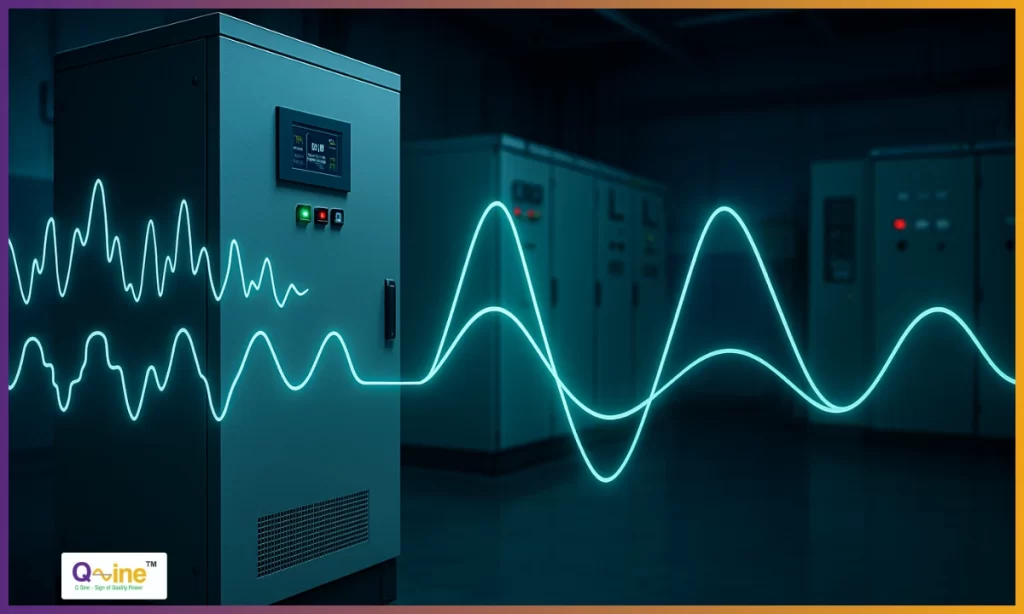
Active harmonic filter (AHFs) is power‐electronics device that clean up distorted current waveforms in industrial power systems. When nonlinear loads (like variable‐speed drives, welding machines, or SCR rectifier based UPS systems) draw current, they introduce harmonics – extra waveform frequencies that distort the pure sine wave.
These harmonics can cause overheating, inefficiency, and even trigger equipment faults. An AHF continuously monitors the load currents and inject compensating currents of the same amplitude but opposite phase to the unwanted harmonics. In effect, it “cancels out” the distortion, so the utility grid sees only a nearly perfect sinusoidal current.
Figure: Industrial active harmonic filter (AHF) unit used in a power system to mitigate current distortions. In practical terms, an AHF is installed in parallel with the power system, typically as a compact electronic cabinet. Inside it uses fast-switching IGBT (as Q Sine notes, “IGBT based Active Harmonic Filters”) to respond instantaneously to load changes. When the AHF detects a harmonic in the load current, it injects a corrective current that exactly cancels that harmonic component. For example, running multiple 6-pulse drives may produce strong 5th, 7th and 11th harmonics; when the AHF is activated, it injects inverted 5th, 7th and 11th currents, resulting in a nearly clean waveform and very low total harmonic distortion. In summary, AHF units actively balance three-phase loads and shape the current wave so that only the fundamental frequency is drawn from the utility.
Key Benefits of Active Harmonic Filters
Active filters offer several advantages over traditional passive solutions. They can target a wide range of harmonic orders and adapt instantly as loads change. In everyday terms, deploying an AHF can yield:
- Harmonic reduction to meet IEEE‑519 standards. Modern AHF systems typically reduce total harmonic distortion (THD) below 8%, ensuring compliance with power quality limits.
- Improved power factor. By compensating reactive currents from inductive loads, an AHF helps maintain a unity (or near-unity) power factor. This saves on utility penalties and frees up capacity in the electrical system.
- Load balancing. AHF units distribute currents evenly across the three phases. This prevents any one phase from being overloaded and keeps the neutral conductor from overheating.
- Reduced equipment stress and downtime. Filtering out harmonics means motors, transformers, and switchgear run cooler and more reliably. AHF deployment often prevents nuisance trips and unexpected equipment failures caused by distorted currents.
- Lower energy costs. With harmonics removed, the power system operates more efficiently. Less wasted energy means lower electricity bills over time.
These benefits are widely documented. For example, Q Sine reports that adding AHF units to an industrial load reduced THD from 15% to as low as 6%. In one case, a paper mill saw THD fall from 18% to 7% after a 200 A AHF was installed. In another, a hybrid solution with an SVG handling reactive power and an AHF handling harmonics raised power factor to 0.995 and achieved full IEEE-519 compliance.
How AHF Units Fit into Power Systems
Active filters are often part of a broader power quality solution. In many facilities, AHFs are combined with static Var compensators or used in hybrid filters for complete correction of power factor and harmonics. For example, static Var Generators (SVGs) are dedicated to reactive power support, while AHFs clean harmonics. Advanced systems may embed both functions: some SVGs even include internal harmonic filtering. In practice, engineers may install both devices in parallel. As one Q Sine case study noted, “Active correction of PF by SVG and Harmonics by AHF” yielded a PF of 0.995 and met IEEE-519 harmonic limits.
More broadly, hybrid filters merge passive and active technologies. These units pair passive reactors/capacitors with an active inverter stage. They combine the fast response of AHF with the bulk reactive capacity of capacitors. Hybrid filters are designed so that the active part rapidly compensates harmonics and dynamic imbalances, while the passive part provides steady reactive power. This hybrid approach covers a wide harmonic spectrum (3rd, 5th, 7th, 11th, etc.) and maintains THD at acceptable levels. According to Q Sine’s technical discussion, key specs like response time (often under 10 ms) and adaptive control ensure that hybrid filters quickly stabilize any disturbance. In essence, an AHF can be viewed as the “active core” of such a hybrid solution: it provides the dynamic, waveform-specific correction that passive components cannot.
In all cases, AHF units are designed to be modular and scalable. Typical filters come in ratings from a 60 to 1000 amperes and can be paralleled for very large loads. Importantly, once an AHF has supplied its maximum harmonic current, it simply stops injecting more – it cannot “overload” and cause instability. This feature makes them safe and reliable under heavy harmonic stress.
AHF in Sustainable Energy Systems
Active filters play a key role in modern, sustainable energy management. Renewable energy systems (solar inverters, wind turbine converters) and Battery Energy Storage Systems (BESS) use power electronics that can introduce harmonics and fluctuating loads. Without filtration, these distortions can spread into the grid or even affect other equipment. By installing AHF units alongside solar and BESS installations, operators ensure that the electricity remains clean and balanced. Cleaner waveforms improve inverter efficiency and extend equipment life.
For example, solar arrays and inverters often create multi-kilowatt harmonic content; coupling them with AHFs allows the facility to export truly sinusoidal power. In a combined solar + BESS environment, AHF devices work together with other solutions (like SVGs or passive filters) to deliver stable voltage and power factor. This synergy is essential in integrated energy solutions, as discussed in Q Sine’s blogs on Solar and BESS integration and energy-saving technologies. The result is a power system that meets IEEE-519 standards without sacrificing efficiency. As studies show, adding effective filtering can yield energy savings of approximately 5–15% by eliminating reactive losses.
Conclusion
Active harmonic filter units are a powerful tool for any facility facing power quality issues. By injecting counter-harmonic currents, they clean the supply waveform and relieve stress on electrical equipment. The benefits – from compliance with harmonic standards to better power factor and lower utility bills – are substantial. In practice, AHFs are often deployed alongside static Var generators or as part of hybrid filter systems to handle the full spectrum of power conditioning tasks. For sustainable and efficient energy management, especially in plants using solar, batteries, or heavy electronic loads, AHFs help ensure the energy is as clean as possible. In short, active harmonic filters are a state-of-the-art solution that greatly enhance power quality and system reliability.