
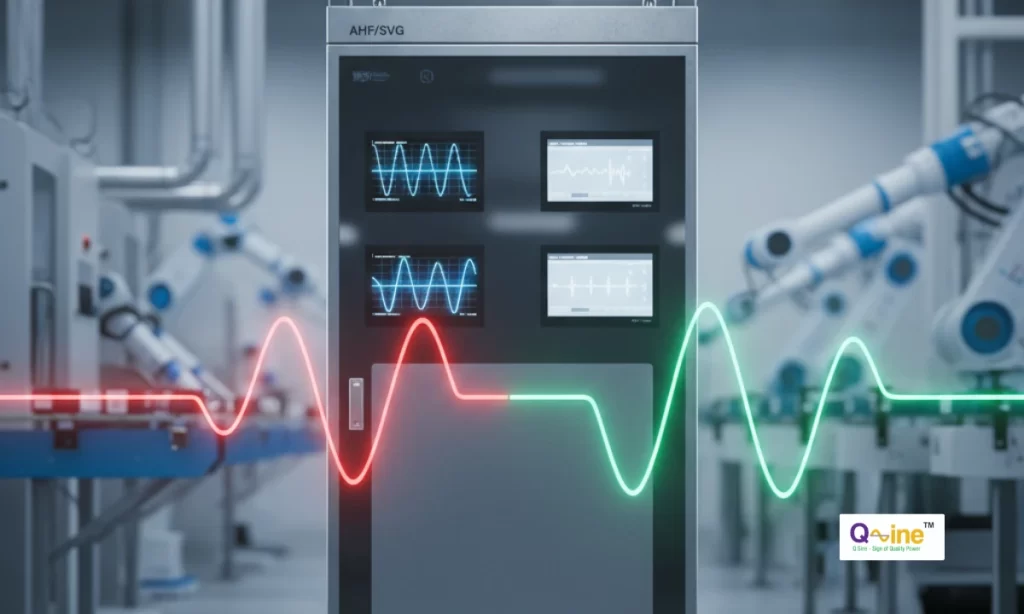
The industrial landscape across India is undergoing rapid modernization, characterized by an increasing reliance on high-speed electronic equipment. Modern facilities now depend heavily on non-linear loads such as Variable Frequency Drives (VFDs), sophisticated rectifiers, large Uninterruptible Power Supply (UPS) systems in data centers, and extensive LED lighting systems. While these technologies drive efficiency, precision, and automation—crucial elements for competitiveness—they fundamentally change the nature of the electrical load on a facility.
The traditional assumption that low power factor is caused solely by inductive loads like older induction motors no longer holds true. Today, plant managers, facility operators, and electrical engineers must contend with a dual threat to operational stability, each demanding a distinct solution: reactive power inefficiency and harmonic distortion. Ignoring this dual challenge leads directly to measurable financial losses and substantial risks to operational continuity.
Defining the Dual Threat to Operational Efficiency
The first common issue is Reactive Power (VARs). This is the non-working power that cycles, or oscillates, between the source and the load, performing no useful work. Excessive VARs lead to a low power factor (PF), which strains the transmission and distribution infrastructure by requiring the utility to supply more total current for the same amount of useful work. For Indian businesses, this inefficiency carries a critical financial penalty: utilities often assess substantial power factor penalties if a facility’s score dips below the mandated thresholds, typically 0.8 or 0.9. These financial implications underscore why power factor correction remains an essential management task.
The second, and increasingly critical, issue is Harmonic Distortion (THD). Non-linear loads—like the rectifiers in VFDs that convert AC to DC—do not draw current smoothly in a perfect sine wave; instead, they draw current in short, high-energy pulses.5 This process injects distorted waveforms, known as harmonics, into the system, effectively polluting the clean, 50Hz sinusoidal power wave. Unmitigated harmonics introduce severe operational instability, manifesting as equipment overheating, significant voltage variation, component failure, and expensive production interruptions.
A critical realization for modern power management is that high harmonic distortion is, in fact, classified as distortion reactive power, making it a primary driver of overall low power factor. This means that simply compensating for VARs using traditional, basic capacitor banks—while addressing the financial penalty—often fails to remove the underlying pollution. This pollution reduces the lifespan of the capacitor banks themselves. True power factor correction in the modern era requires specifically removing the harmonic currents before effective VAR compensation can take place. Comprehensive power quality management therefore demands a dynamic solution capable of addressing both issues simultaneously, requiring the synergy found in combining the Active Harmonic Filter (AHF) and the Static Var Generator (SVG) within a hybrid architecture.
Active Harmonic Filters (AHF): The Clean Power Specialists
The Active Harmonic Filter (AHF), sometimes referred to as an Active Power Filter (APF), is specialized equipment designed entirely to eliminate harmonic distortion.5 It functions as a dynamic system cleaner, ensuring that the power supply flowing through the system remains stable and purely sinusoidal.
AHFs operate using advanced Insulated Gate Bipolar Transistor (IGBT) technology. The mechanism involves a crucial, two-step compensation process performed in real-time. First, the AHF continuously monitors the current drawn by the load, instantly sensing the exact magnitude and phase of the distorting harmonic currents across all three phases. Second, the device instantly injects a precise, equal, and opposite counter-current onto the line. This opposing current cancels out the detected harmonics at the point of common connection, effectively smoothing the current waveform, reducing Total Harmonic Distortion (THD), and optimizing the performance of sensitive electrical equipment.
This dynamic correction process is exceptionally fast, boasting a response speed typically less than 1 millisecond (<1ms). This rapid reaction time is essential for providing superior protection to delicate electronic controls, such as PLCs (Programmable Logic Controllers) and VFDs, shielding them from damaging transients caused by sudden load changes in a fast-paced manufacturing environment. Beyond providing a clean power supply, AHFs translate directly to operational gains by reducing electrical stress, lessening wear and tear, lowering maintenance costs, and helping facilities achieve targeted power quality standards.
Static Var Generators (SVG): Dynamic Reactive Power and Voltage Stability Experts
In contrast to the AHF’s focus on current purity, the Static Var Generator (SVG) is engineered primarily for dynamic reactive power compensation and swift voltage regulation. It represents the modern, high-speed successor to traditional, step-based capacitor banks. SVGs are critical for applications where loads fluctuate rapidly, causing instantaneous voltage dips and swells—a common challenge in environments with heavy machinery or intermittent, large loads.
Like the AHF, the SVG utilizes advanced IGBT technology, enabling it to monitor the system’s reactive power requirements continuously. It dynamically generates or absorbs reactive power (VARs)—whether inductive (lagging) or capacitive (leading)—in real-time to maintain the power factor near unity. The goal is to bring the phase angle of the current almost exactly in line with the phase angle of the voltage, maximizing the transfer of useful power.
SVGs offer a very fast response time, typically under 5 milliseconds (<5ms). This speed allows the SVG to respond instantaneously to voltage variations caused by large, fluctuating industrial loads, such as large motor starts or welding operations, thereby ensuring stable grid voltage across the facility. The immediate financial driver for an SVG in India is the avoidance of substantial utility penalties associated with a low PF. Operationally, dynamic voltage stabilization increases system capacity and reliability throughout the facility. In some advanced configurations, SVGs can also offer limited harmonic mitigation capabilities as a secondary function.
| Solution | Primary Goal | Key Problem Addressed | Technology | Response Speed |
| Active Harmonic Filter (AHF) | Harmonic Distortion Mitigation | High THD, Equipment Overheating, Current Pollution | IGBT-Based Filtering | Extremely Fast (<1ms) |
| Static Var Generator (SVG) | Reactive Power Compensation | Low Power Factor, Voltage Dips/Swells, Utility Penalties | IGBT-Based VAR Control | Very Fast (<5ms) |
| Advance SVG Hybrid (AHF + SVG) | Comprehensive PQ Optimization | THD, Power Factor, Load Unbalance | Integrated Dynamic Control | Real-Time |
The Indispensable Combination: The Power of Hybrid Solutions
A modern industrial facility with significant non-linear loads invariably faces both high harmonic issues and fluctuating VAR demand. In this common scenario, relying on a single, standalone device is often inadequate. A pure AHF may offer only limited reactive power compensation, while a standalone SVG may not provide the precise, dynamic harmonic filtering required to comply with strict THD standards.
The combined, hybrid solution integrates the specialized AHF and SVG functions into a single panel or coordinated system, offering a comprehensive and dynamic defense. This synergy ensures that both major power quality problems—harmonic pollution and reactive power inefficiency—are solved simultaneously and precisely.
The intelligence of the hybrid solution lies in its sophisticated control system. The controller continuously samples the load current in real-time, instantly extracting both the harmonic components and the reactive power components which require correction. It then controls the IGBTs to inject the exact compensatory currents needed. This integrated control ensures unparalleled performance in complex, highly dynamic, and often unbalanced industrial environments.
The hybrid approach is widely recognized for delivering the best “PERFORMANCE UTILISATION INDEX” compared to passive filter solutions or single-function active devices. By cleaning the power quality first with the AHF function and then stabilizing the power factor with the SVG function, the system maximizes efficiency and component lifespan.
While the initial capital investment in advanced dynamic solutions is higher than traditional passive filters like basic capacitor banks, the long-term cost justification is compelling. The presence of harmonics significantly reduces the useful life of capacitor banks due to overheating and stress. A hybrid AHF/SVG solution mitigates electrical losses and drastically extends the life of all connected components by providing a clean supply. Studies show that dynamic harmonic filters, despite a higher upfront cost, achieve a competitive payback period (around 0.6 years) compared to unreliable capacitor banks in harmonic-rich environments, securing lower capital replacement cycles and greatly reduced maintenance costs.
Real-World Results: Measurable ROI for Indian Businesses
For any business, power quality management is not merely a technical compliance exercise; it is a critical pillar of operational resilience. Unmitigated power fluctuations—whether voltage spikes, harmonics, or interruptions—can damage equipment regardless of their duration, leading to substantial financial losses. Moreover, the continually evolving nature of the grid and the introduction of new high-tech loads ensure that power quality challenges, such as voltage unbalance, dips, and swells, will persist.
The benefits of dynamic filtering are validated by success stories in the Indian manufacturing sector. For example, a medium-scale manufacturing facility in Bangalore was grappling with severe power quality issues, including high THD measured at 18%, persistent equipment overheating, and frequent production interruptions. Upon installing a tailored Active Harmonic Filter solution, the facility experienced a remarkable transformation.
The measurable improvements included:
- Total Harmonic Distortion (THD) was reduced dramatically from 18% to below the recommended 5% limit.
- System voltage was stabilized, which directly contributed to extended equipment lifespan.
- Tangible energy savings were achieved.
By investing in a dynamic, hybrid solution, facilities move beyond merely compensating for inefficiency. They establish an advanced, predictive defense that secures substantial cost efficiency gains, reduces costly downtime, ensures power factor compliance to avoid utility penalties, and enhances overall operational reliability for years to come.
Conclusion
For any modern Indian industrial facility facing the dual challenge of sophisticated non-linear loads and the financial pressures of utility penalties, the integrated defense provided by a hybrid AHF and SVG panel offers the ultimate solution. These devices are not interchangeable; they are complementary, each fulfilling a necessary and distinct function. The AHF cleans the power, eliminating distortion, while the SVG ensures efficiency and stability by managing reactive power and voltage in real-time.
To secure this comprehensive protection, the crucial first step is to initiate a detailed Harmonic Analysis to accurately identify the facility’s specific load profile and determine the precise capacity required for a dynamic, integrated solution. By simultaneously addressing both reactive power inefficiencies and harmonic pollution, businesses achieve maximum asset utilization, compliance with power quality standards, and long-term protection for their critical machinery. The future of robust power quality protection for the Indian industry is dynamic, precise, and integrated.