
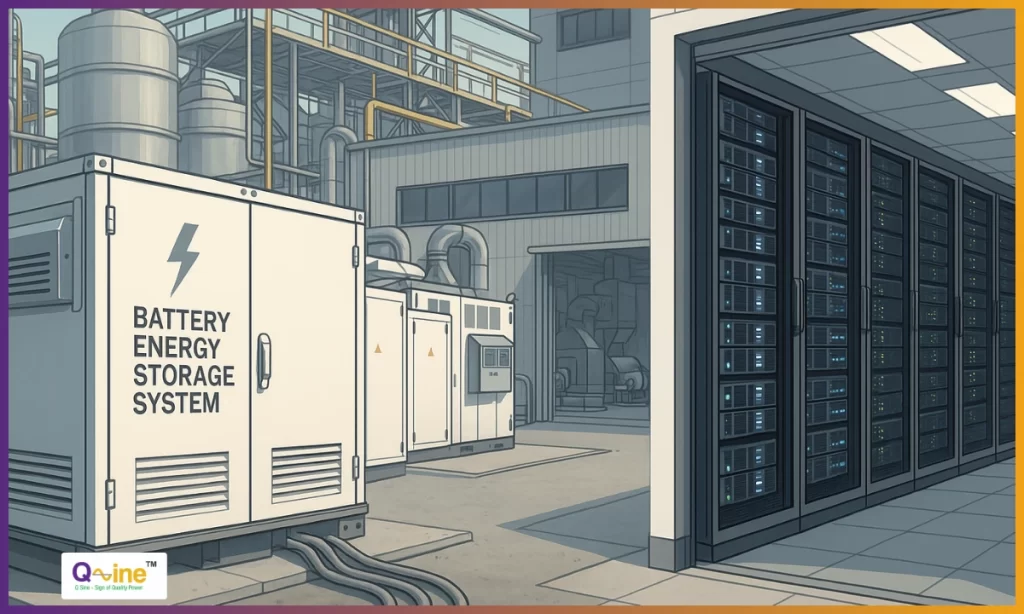
Energy-intensive industries – such as manufacturing plants, data centers, and mining operations – face extremely high operational costs due to their massive energy consumption. A significant portion of these costs comes from electricity usage and demand charges (fees based on peak power usage). In this context, Battery Energy Storage Systems (BESS) have emerged as a game-changing technology.
BESS allows industrial facilities to store electrical energy and use it strategically, helping reduce power-related costs while improving reliability. Industry experts note that adopting BESS can dramatically lower operational expenses by optimizing how and when a facility uses energy.
In simple terms, a BESS acts as a large battery bank for a facility, charging when power is cheap or abundant and discharging when power is expensive or scarce. By leveraging BESS, energy-intensive businesses are finding new ways to shave off their energy bills and enhance their power reliability.
Challenges of High Energy Costs in Industrial Operations
In heavy industries, electricity bills are not just about how much energy is used – when and how that energy is used also heavily influence costs. Many industrial and commercial electricity tariffs include demand charges, which are fees based on the highest level of power demand (in kW or kVA) a facility hits during the billing period. These demand charges can be substantial; studies show they often account for 30% to 70% of a commercial facility’s electricity bill.
This means an energy-intensive factory or data center might pay more for a few spikes in power use than for steady usage spread over time. Furthermore, high energy use often coincides with peak grid hours when electricity rates are highest. Combined with the need for uninterrupted power (to avoid costly downtime), these factors create a significant challenge: how to reduce energy expenses without compromising operations.
This is where BESS comes into play. By intelligently managing energy, charging during low-cost periods and discharging during peaks, a BESS directly tackles the issue of demand spikes and expensive peak energy, offering a practical solution to cut down those hefty operational costs.
Peak Shaving to Minimize Demand Charges
One of the most effective cost-reduction strategies provided by BESS is peak shaving. Peak shaving means using stored energy to supply power during times of highest demand, so that the facility’s draw from the grid stays below a set threshold. By dispatching battery power to flatten out spikes in usage, industries can avoid pushing their demand to the peaks that trigger high charges. This directly translates into savings: if a factory normally hits a 5 MW peak once a month but can cap itself at 4 MW with battery support, the demand charge portion of its bill will be lower. In fact, by shifting usage from high-cost periods to cheaper off-peak times, a well-sized BESS can reduce peak demand charges significantly
Real-world examples illustrate the impact. In the metals manufacturing sector, battery storage is prized for lowering operational costs by shaving peaks and avoiding utility demand charges. For instance, Schnitzer Steel Industries installed a 1.6 MW / 5.5 MWh BESS at one of its recycling facilities to do exactly this – the battery charges when demand is low and discharges to cover spikes, thereby reducing the plant’s peak power draw and its associated costs.
Across many industries, peak shaving via BESS has become a key strategy to manage demand charges, ensuring that factories and plants aren’t paying exorbitant fees for short bursts of power use.
Load Shifting for Time-of-Use Optimization
Closely related to peak shaving is the concept of load shifting, another cost-saving benefit of BESS. Electricity prices often vary throughout the day – for example, power might cost much more during afternoon peak hours than late at night. BESS allows industrial users to take advantage of these price differences.
The strategy is simple: charge the batteries when electricity is cheap (for instance, at night or during periods of low grid demand) and use the stored energy when electricity is expensive. By doing so, a facility can drastically cut its energy bills by avoiding purchases of high-priced power. This practice is sometimes called “energy arbitrage” – buying low, using high – and it can yield substantial savings for energy-intensive operations.
Load shifting also has the side benefit of easing strain on the grid during peak times, which can be important for grid stability. For the industry, however, the main attraction is financial: a BESS effectively buffers the facility against time-of-use rate spikes. For example, a large manufacturing plant might charge its battery bank in the early morning when rates are low, then at noon when tariffs peak, the batteries supply part of the power. The result is a lower average energy cost per kWh consumed.
Over time, this adds up significantly on the bottom line. Many energy-intensive industries, from cement factories to food processing, use this technique to optimize energy procurement. By smoothing out when power is drawn from the grid, BESS enables facilities to operate more on inexpensive energy and less on costly peak-hour electricity.
Backup Power and Enhanced Reliability (Avoiding Downtime Costs)
Unexpected power outages or even brief fluctuations can be devastating for operations like assembly lines or data centers. Downtime means lost production, spoiled batches of product, or service disruptions – all of which carry heavy costs. BESS provides a critical buffer here by acting as a fast-response backup power source. In the event of a grid failure or even micro-interruptions, a battery system can kick in almost instantaneously to keep vital equipment running. This enhanced reliability directly protects against the financial losses associated with downtime.
Consider data centers: a momentary power loss can knock servers offline, potentially costing hundreds of thousands of dollars per incident. Industry data shows that even brief data center outages can cost as much as $1 million for large facilities. By installing BESS, data centers ensure an uninterruptible power supply that can bridge the gap until backup generators start or the grid recovers, thereby avoiding those enormous outage costs.
BESS can also replace or augment diesel generator backups in many industrial settings. Traditionally, factories and critical facilities rely on diesel gensets for emergency power. However, diesel generators have drawbacks: they take time to ramp up, incur fuel and maintenance costs, and run inefficiently under light loads. A BESS, on the other hand, delivers power instantly with zero fuel cost.
For example, tech companies like Microsoft have begun replacing diesel backup units with large battery storage systems at their data centers. The batteries not only eliminate fuel expenses and emissions, but also provide black start capability (rapidly restoring power without external help) and can even support the grid when needed. In industrial plants, batteries often work in hybrid with generators: the BESS supplies power for short or small bursts, allowing diesel engines to run at optimal load or remain off unless absolutely needed.
This hybrid approach reduces generator runtime and fuel consumption, extends generator lifespan by avoiding inefficient stop-start cycles, and lowers maintenance costs. Overall, by ensuring continuous power and reducing reliance on costly backup generators, BESS improves operational continuity and yields significant savings. The peace of mind from enhanced power reliability is an added bonus – one that industry managers value just as much as the direct cost reductions.
Fuel Savings and Emissions Reduction in Remote Operations
In certain energy-intensive sectors like mining, oil & gas, or remote manufacturing, facilities often generate power on-site using diesel or gas turbines. These operations can benefit immensely from BESS through fuel savings.
Batteries can be used to smooth out the power supply, taking on rapid load changes so that diesel generators run at steady, optimal levels. By covering peak loads and transient spikes with battery power, companies can avoid firing up additional generators that would only be needed for short durations. This translates into burning less fuel. On off-grid oil rigs or mines, for example, a BESS can cut down the hours that diesel gensets need to operate, leading to substantial fuel cost savings over time. One case study on an offshore drilling rig showed that a battery hybrid system eliminated peak load spikes that would have required multiple generators, thereby slashing fuel use and generator wear and tear. Furthermore, remote industrial sites typically face very high fuel logistics costs (shipping diesel to a remote mine is expensive). Every liter of diesel saved by the battery is a direct reduction in operating expense.
There’s also a strategic environmental benefit that often aligns with cost savings here. Using BESS to reduce generator usage lowers greenhouse gas emissions and pollution.
Many large industrial firms have sustainability goals, and cutting fuel consumption helps meet those targets while saving money. For instance, in the mining industry – where energy can comprise around 40% of a mine’s total operating costs – incorporating solar generation with BESS is becoming popular to displace diesel power. Mining company BHP, for example, paired a 10.1 MW battery with solar farms at an Australian site to reduce its dependence on diesel and gas, aiming to trim both energy costs and emissions.
In summary, for remote or fuel-intensive industrial operations, BESS technology offers a double win: lower operational costs via fuel savings, and progress toward cleaner energy use.
Integrating Renewable Energy for Cost Efficiency
Another way BESS reduces costs is by enabling greater use of on-site renewable energy, such as solar panels or wind turbines, in industrial settings. Many commercial and industrial facilities are investing in renewable generation to save on electricity and meet sustainability targets.
However, renewables are intermittent – the sun and wind don’t always align with a factory’s work schedule or a data center’s 24/7 demand. BESS resolves this by capturing excess renewable energy and making it available on demand. During sunny periods or windy nights, a battery system can store surplus solar/wind power that would otherwise be wasted or sold cheaply to the grid. Later, during high-demand periods or when the renewable source is off (e.g. nighttime), the stored energy is used to power the facility.
This means the facility draws less (or even zero) power from the grid during expensive peak times, instead relying on the cheap, clean energy it banked earlier. The outcome is a lower electricity bill and greater energy independence.
For example, a cement manufacturing plant in Colorado integrated a BESS with a solar PV array, aiming to supply roughly 40% of the plant’s energy needs internally. The battery’s role is pivotal: it ensures the plant can reduce drawing power from the grid during peak periods by using stored solar energy. This not only saves on costs but also shields the facility from price volatility. In general, by stabilizing renewable output, BESS makes sure that industrial sites get the maximum financial benefit from their solar or wind installations.
Excess generation at midday can be shifted to cover evening manufacturing shifts, for instance. Companies that have deployed solar-plus-storage solutions report drastic cuts in grid consumption and demand charges, effectively turning renewable investments into round-the-clock cost savers. (For more on leveraging solar in industrial settings, see our post on Solar Solutions for Commercial and Industrial Applications.)
The synergy of renewables with BESS thus allows energy-intensive industries to achieve both cost efficiency and sustainability goals simultaneously – a critical advantage in today’s market.
Economic Feasibility and ROI Considerations
While the cost-saving potential of BESS is clear, businesses must also consider the economics of implementing such systems. Battery storage installations require upfront investment, and the financial returns depend on factors like the facility’s load profile, electricity tariff structure, and available incentives.
The good news is that the cost of battery has been declining steadily, making BESS more financially attractive year by year. Additionally, many regions offer demand response programs, tax credits, or rebates that improve the business case for batteries. Forward-looking companies often conduct a cost-benefit analysis of implementing BESS (as discussed in our related article) to project the payback period.
In energy-intensive industries, this analysis frequently shows that BESS can pay for itself in a few years through energy savings alone. Peak shaving and load shifting savings, when combined with avoided outage costs and reduced generator fuel use, tend to yield a strong return on investment over the system’s lifetime. Moreover, modern financing models – such as energy storage-as-a-service or leasing – allow firms to deploy BESS with minimal upfront capital, paying over time out of the savings generated.
This means even companies with tight budgets can access the operational cost reductions that BESS provides. Ultimately, when evaluating ROI, it’s important to look not just at direct energy cost savings but also at the operational resilience and power quality improvements that are harder to quantify but equally valuable. Many industry leaders view BESS as a strategic investment in future-proofing their operations against energy price hikes and grid unreliability.
Conclusion
Battery Energy Storage Systems are transforming how energy-intensive industries manage power usage and costs. By flattening peak demand, shifting energy consumption to optimal times, and providing reliable backup power, BESS enables factories, data centers, and other heavy power users to significantly lower their electricity expenses without compromising operations. These systems tackle the very pain points that drive up energy bills – from hefty demand charges to inefficiencies in energy timing and costly unplanned outages.
Just as importantly, BESS improves operational resilience; facilities become less vulnerable to grid disruptions and more capable of using their own on-site energy resources efficiently. In an era of rising energy prices and sustainability pressures, adopting BESS is quickly becoming a best practice for cutting costs and enhancing competitiveness in industrial sectors.
The technology’s benefits extend beyond economics, too – reduced fuel use and higher renewable utilization contribute to cleaner, more sustainable operations.
In summary, BESS offers a practical, proven way for energy-intensive industries to save money while modernizing their power systems. It’s an investment in both immediate operational savings and long-term strategic flexibility, making it a compelling solution for companies looking to thrive in the face of energy challenges.