
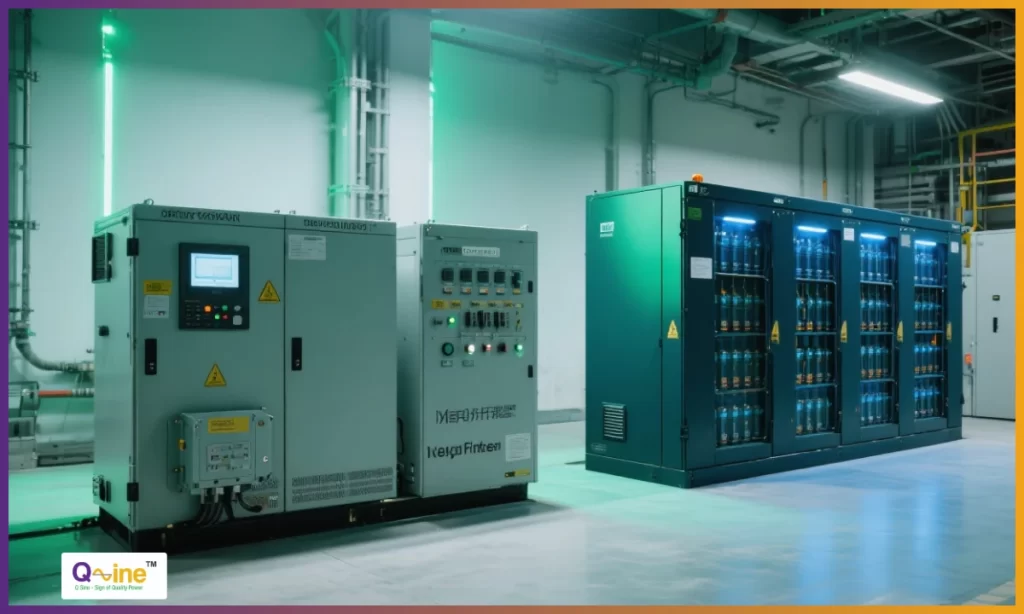
Industrial power systems today must control harmonics and reactive power to operate efficiently and avoid penalties. The IEEE 519 standard sets strict limits on harmonic distortion and power quality. Nonlinear loads (like drives, LED lights, computers) can create high harmonics that exceed these limits.
Excessive harmonics cause equipment overheating, erratic tripping, and energy losses. Engineers must manage these issues, or face equipment damage, downtime, and higher costs.
Key requirements: IEEE 519 defines maximum Voltage distortion limits at the Point of Common Coupling (PCC). For example, at a typical low-voltage bus (≤1.0 kV), total harmonic distortion (THD) must stay below 8%, while at medium voltage (1–69 kV) THD is limited to 5%. Current distortion limits depend on grid strength (short-circuit ratio).
In practice, maintaining these limits means reducing distortion from industrial machinery. For instance, one case needed to cut current THD from 22% to under 6% to meet the ≤8% limit.
Industrial sites often tried traditional solutions like capacitor banks or tuned passive filters. These improve power factor in steps but struggle with harmonics. Capacitors only add fixed reactive power and can even resonate with some loads, amplifying harmonics.
In contrast, modern devices use active electronics to adapt in real time. Hybrid filters – which combine passive elements with an active filter (often an ASVG) – deliver smooth, continuous correction.
For example, a hybrid filter system can operate sleeplessly (unlike older stepped APFC panels) and also reduce harmonics. This keeps power factor near unity and avoids distortion.
Advanced Static Var Generators (ASVG)
An ASVG is essentially an partial active harmonic filter and dynamic reactive power compensator. It monitors the load current waveform and injects a counter-current that cancels out harmonics. This happens automatically and very quickly (usually in milliseconds). Modern ASVGs can raise power factor to almost 1.0 while driving THD down below IEEE 519 levels.
For example, one source notes that active filters “dynamically measure and counteract harmonic distortions in real time,” resulting in “reduced harmonic current levels to meet IEEE 519 thresholds”.
In simple terms, ASVGs behave like very fast, smart power factor correction devices. They respond instantly to load changes (often under 10 ms) to keep the system clean. Unlike a bank of fixed capacitors, an SVG can both source and sink reactive power continuously. This means it can handle both lagging and leading power factor conditions without manual switching. (See our static var generators (SVG) overview for more on SVG applications.)
Hybrid Filters
A hybrid filter combines a passive branch (capacitors and inductors) tuned to some harmonics with an active branch (an ASVG or active filter) that cleans up the rest. This synergy makes hybrid filters cost-effective: the passive part handles low-order, high-energy harmonics, while the active part corrects whatever remains. For example, Q Sine’s hybrid filters are described as the “optimum cost solution to manage power factor with the combination of active and passive components”.
They maintain PF close to unity and can even mitigate harmonics up to about 50% of their rated capacity. In practical terms, a hybrid filter keeps energy flowing smoothly and cleans up distortion. As one case study showed, adding a hybrid filter with an advanced SVG brought the PF close to Unity and cut total current THD below 6% – well within the 8% THD limit for their system. The result was major energy savings and no more resonance problems.
Battery Energy Storage Systems (BESS)
Battery systems add flexibility on both the active and reactive side. A BESS can store excess energy when loads are low and discharge when loads spike, which helps flatten demand and reduce stress on the grid. Importantly, the inverter in a BESS can also provide reactive power (VAR support) while discharging or charging. In other words, a BESS can simultaneously deliver active power and reactive power to stabilize voltage.
For example, a well-sized BESS might be rated to supply, say, 20 MW of real power and 20 MVAr of reactive power at the same time. This makes it useful for voltage control and power factor correction.
Integrating BESS with harmonic filters creates a very modern solution: the energy storage handles bulk power and peak shaving, while SVGs/hybrid filters fine-tune the waveform. This combination can easily meet IEEE 519 limits even under heavy nonlinear loads.
Modern solution benefits
Together, SVGs, hybrid filters, and BESS form a hybrid power factor correction system. Key advantages include:
- Continuous correction: Active filters like ASVGs adjust instantly, unlike stepped capacitor banks.
- Harmonic cleanup: They inject counter-harmonic currents to keep THD low.
- Efficiency and savings: Lower losses and no penalty charges mean cost savings. In one case, PF went from 0.93 to 1.0 and THD dropped from 22% to under 6%.
- System protection: With harmonics under control, equipment runs cooler and lasts longer, and circuit breakers no longer nuisance-trip.
In summary, meeting IEEE 519 today means using smarter power quality equipment. Advanced Static Var Generators and active filters deal with changing loads and harmonics in real time. Hybrid filters combine active and passive methods for efficient correction.
Battery storage adds extra support and smooths out fluctuations. By deploying these modern solutions, facilities not only comply with IEEE 519 but also boost reliability and cut energy waste. For more details on choosing the right equipment, see our hybrid filter introduction and BESS case study.