Q Sine Energy Solutions Pvt. Ltd is a Pune-based ISO 9001:2015-certified power quality and energy management manufacturer with 550+ installations across India. kVAh billing charges Maharashtra’s LT consumers for apparent energy, not just the active energy their machines use. MSEDCL now meters apparent energy directly, so low power factor inflates billed units even when consumption stays flat. At 0.85 power factor, that shift adds roughly 18% to every bill before any machine runs harder. MERC’s order in case No. 217 of 2024 extended kVAh billing to LT consumers with a sanctioned load above 20 kW from 1 July 2025. MSEDCL’s LT-Industry FY 2025-26 tariff is Rs 6.69 per kVAh plus Rs 390 per kVA fixed, so every drop in power factor compounds into rupees. This guide explains kVAh billing, its cost to a poor-PF plant, and how correction pays it back.
Key Takeaways
- MERC Order 217/2024 moved LT consumers above 20 kW to kVAh billing from 1 July 2025.
- kVAh billing folds Maharashtra’s old power factor penalty into every unit billed, with no separate incentive slab.
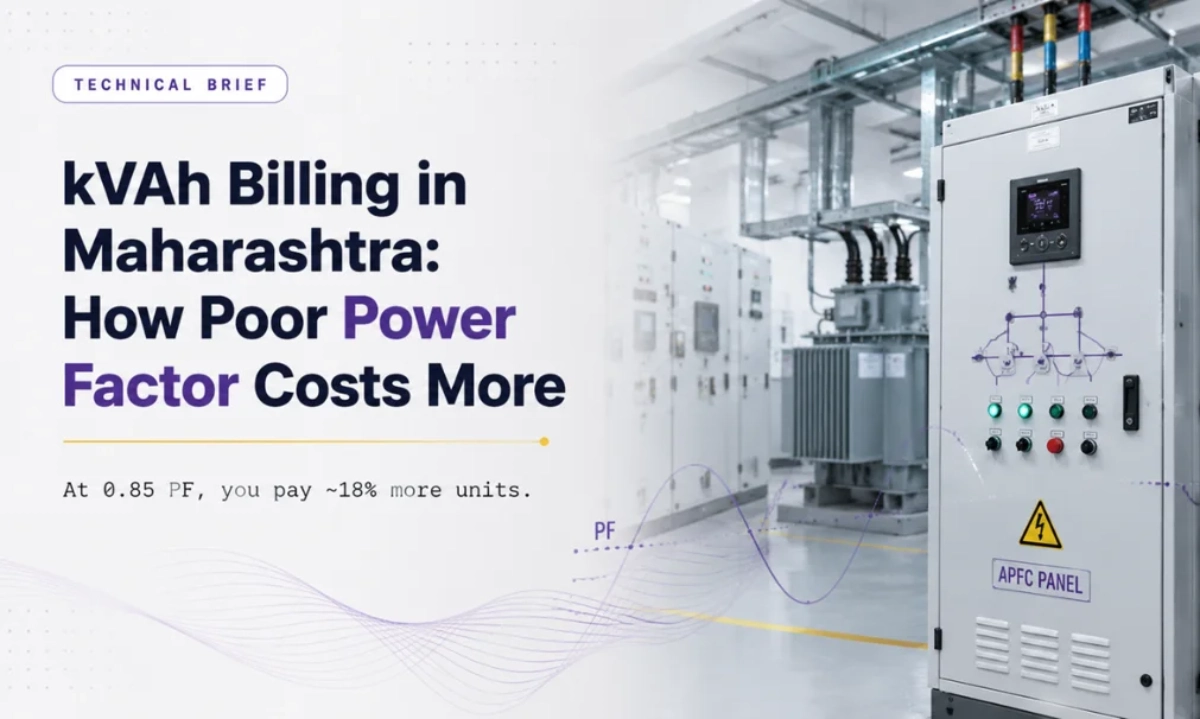
- At 0.85 power factor, a plant pays for roughly 18% more units than it actually consumes.
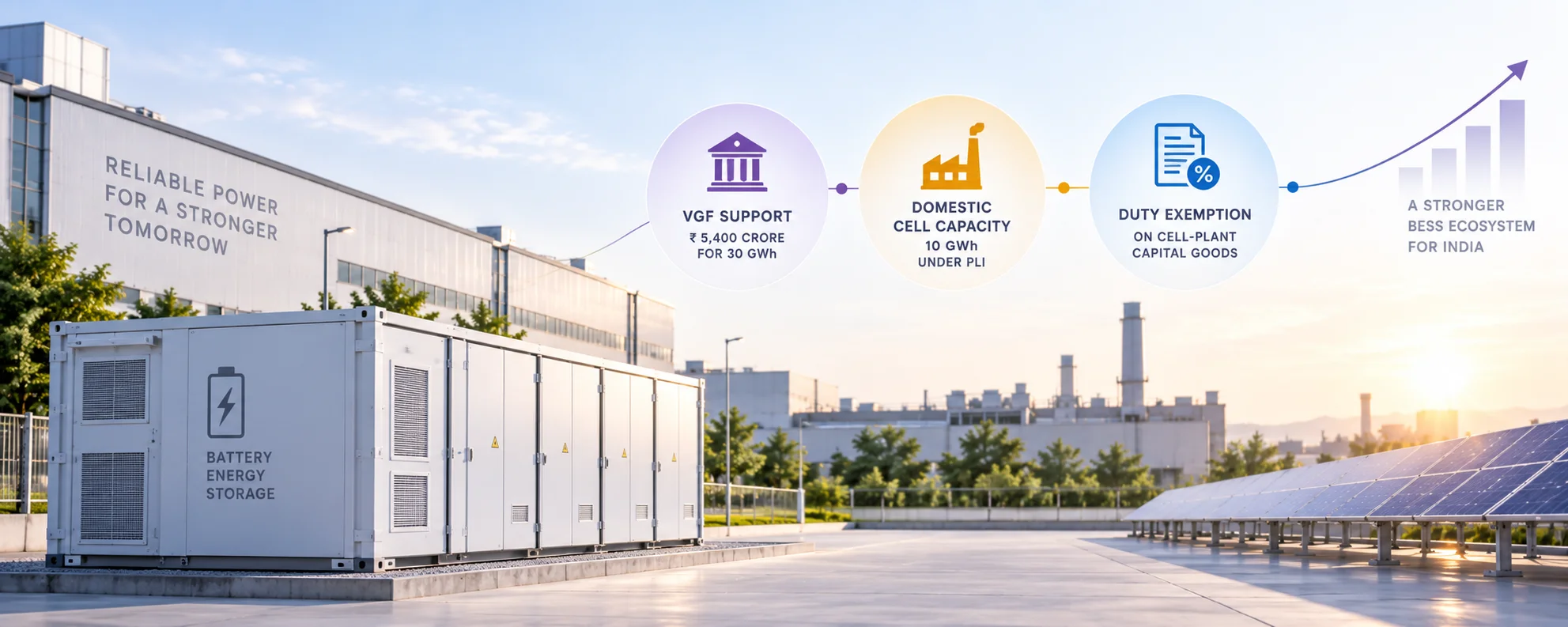
- MSEDCL’s FY 2025-26 LT-Industry rate above 20 kW is Rs. 6.69 per kVAh plus Rs. 390 per kVA fixed.
- APFC and RTPFC panels correct PF toward unity; PF correction payback typically runs 12 to 18 months.
What is kVAh billing, and how does it work in Maharashtra?
kVAh billing bills a consumer for apparent energy (kVAh), the vector sum of active energy (kWh) and reactive energy (kVArh), instead of billing active energy alone with a separate power factor penalty. MERC’s order in case no. 217 of 2024 applies this method to all LT consumers in Maharashtra with a sanctioned load above 20 kW, effective from 1 July 2025.
Before this order, LT industrial consumers paid for kWh consumed and carried a separate power factor penalty only if PF fell below 0.90 or an incentive if it rose above 0.95. That mechanism is gone for connections above 20 kW. MSEDCL identifies and bills kVAh through trivector meters already installed at most qualifying connections, which record active, reactive, and apparent energy on the same register. HT consumers in Maharashtra have been billed on kVAh since 1 April 2020 under an earlier MERC order; this MYT order extends the same principle down to LT connections.
How Much Does Poor Power Factor Cost Under kVAh Billing?
A plant running at a 0.85 power factor draws roughly 18% more apparent energy than its real consumption, because kVAh rises as the power factor falls below unity. On a connection billed at MSEDCL’s FY 2025-26 LT-Industry rate of Rs. 6.69 per kVAh, that gap adds real rupees to every monthly bill, independent of any change in production.
A plant consuming 10,000 kWh a month at unity power factor is billed 10,000 kVAh. The same plant at 0.85 PF is billed close to 11,765 kVAh for identical output, since apparent energy rises as the kWh-to-kVAh ratio falls. At Rs 6.69 per kVAh, that difference alone adds roughly Rs 11,810 a month, before fixed and wheeling charges. The table below shows the billed-unit gap across common power factor bands, using the same 10,000 kWh baseline.
| Power Factor | Billed kVAh | Extra Units | Extra Monthly Cost |
| 1.00 (Unity) | 10,000 | 0 | ₹0 |
| 0.95 | 10,526 | 526 | ₹3,520 |
| 0.90 | 11,111 | 1,111 | ₹7,430 |
| 0.85 | 11,765 | 1,765 | ₹11,810 |
| 0.80 | 12,500 | 2,500 | ₹16,725 |
*kVAh vs. kWh billed for 10,000 kWh of actual (real) consumption. **At MSEDCL’s FY 2025-26 LT-Industry (above 20 kW) energy charge of Rs. 6.69 per kVAh. Fixed and wheeling charges are additional.
How Can Industrial Plants Correct Power Factor Under kVAh Billing?
APFC and RTPFC panels correct power factor toward unity by switching capacitor banks or thyristor-controlled reactive power in real time, shrinking the gap between kWh and kVAh. For a plant correcting from 0.85 to 0.98 PF, the billed-unit reduction typically repays the panel cost within 12 to 18 months.
APFC panels use contactor-switched capacitor stages and suit stable loads; RTPFC panels use thyristor switching and respond in milliseconds, which matters for VFD-heavy or welding-heavy plants where PF swings within a single production cycle. A power quality audit measures the actual kWh-to-kVAh gap on each incoming feeder before sizing either solution, so correction is matched to real reactive power demand rather than a nameplate estimate.
Does kVAh billing replace Maharashtra’s old power factor penalty?
Yes. Under MERC’s Order in Case No. 217 of 2024, MSEDCL no longer applies a separate PF penalty to LT consumers above 20 kW. The meter records apparent energy (kVAh) directly, so low PF is billed automatically through higher units.
From when does kVAh billing apply to LT consumers in Maharashtra?
kVAh billing applies to LT consumers with sanctioned load above 20 kW from 1 July 2025, under MERC’s Order in Case No. 217 of 2024. HT consumers have billed on kVAh since April 2020. Consumers below 20 kW remain on standard kWh billing.
How much can PF correction save under kVAh billing?
Correcting power factor from 0.85 to 0.98 cuts billed kVAh by roughly 13%, since apparent energy falls as PF approaches unity. At MSEDCL’s FY 2025-26 LT-Industry rate of Rs. 6.69 per kVAh, that reduction typically pays back an APFC or RTPFC installation within 12 to 18 months.
References
- Maharashtra Electricity Regulatory Commission. MERC Order, Case No. 217 of 2024. Multi-Year Tariff Order for MSEDCL, FY 2025-26 to FY 2029-30, dated 28 March 2025. Point 16 (kVAh billing for LT consumers above 20 kW) and Annexure 3 (LT-Industry tariff, FY 2025-26). merc.gov.in/wp-content/uploads/2025/03/Press-Note_MSEDCL-MYT-Order_English.pdf
- MSEDCL. kVAh Billing – Frequently Asked Questions, referencing MERC Order Case No. 195 of 2017 dated 12 September 2018 (kVAh billing for HT consumers and LT consumers above 20 kW effective 1 April 2020). mahadiscom.in/wp-content/uploads/2020/01/002_ANNEXURE-6_FAQs-REGARDING-kVAh-BILLING.pdf
- MSEDCL. Tariff Details. Official document listing for MYT Order, Case No. 217 of 2024. mahadiscom.in/en/consumer/tariff-details/
Continue Reading
Get free access to this article and stay updated with Q Sine's latest insights on power quality and energy solutions. No spam, ever.
You're in!
Unlocking the full article now…
Your details are safe. We never share or sell your data.