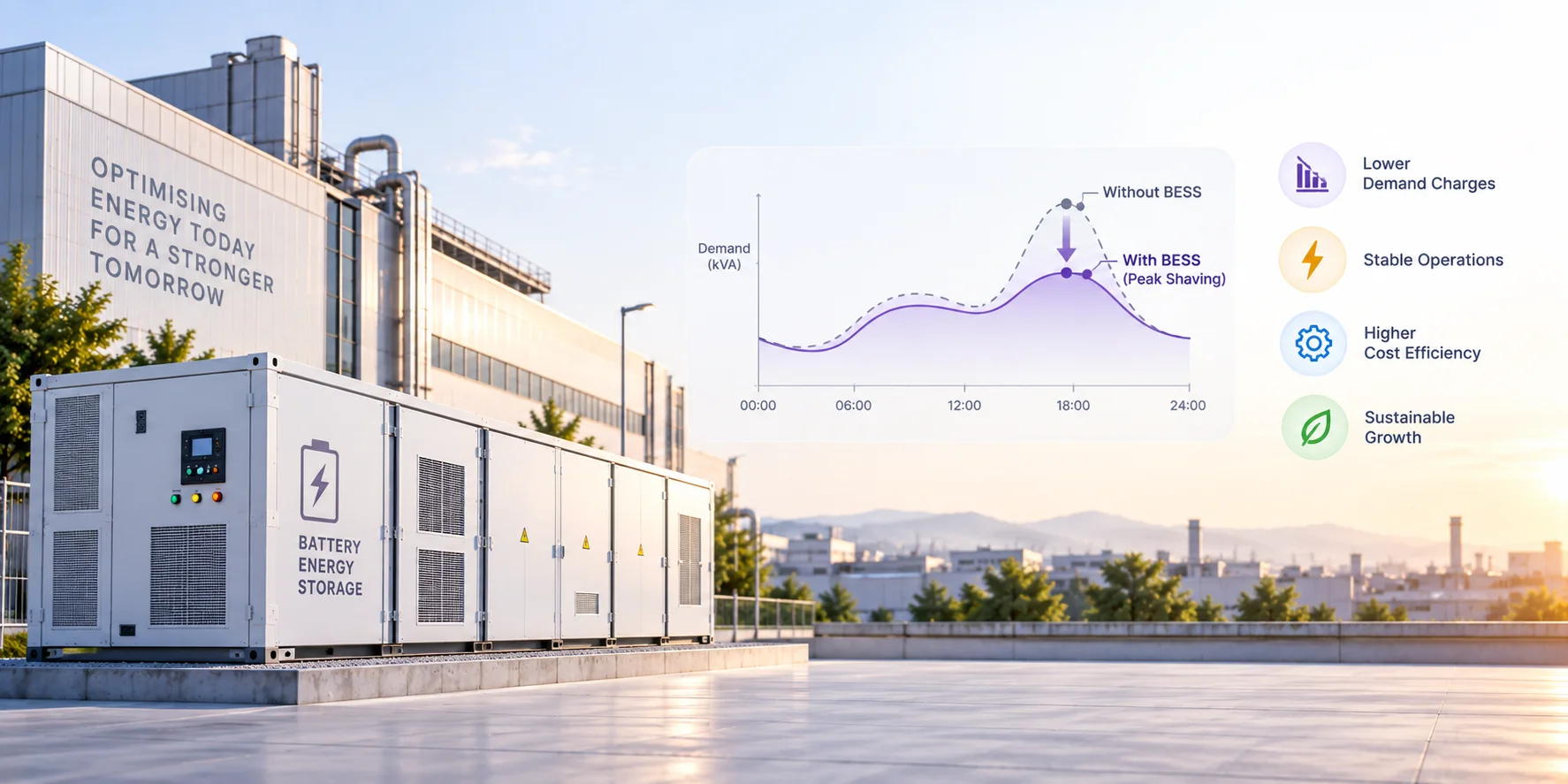
Q Sine Energy Solutions is a Pune-based power quality and energy management manufacturer with 30+ years of experience and 550+ installations across India. A Battery Energy Storage System (BESS) is a grid-connected or islanded energy storage device that charges during off-peak periods and discharges stored power during demand peaks, reducing the maximum load drawn from the distribution network at any 15-minute or 30-minute interval measured by the utility.
Q Sine manufactures BESS configurations from 50 kWh to multi-megawatt-hour capacity, using LFP (lithium iron phosphate) chemistry with a bidirectional AC/DC power conversion system and a battery management system to protect cells and optimise cycle life. These systems integrate directly with existing plant infrastructure to target the single largest controllable cost on an industrial electricity bill: the maximum demand (MD) charge.
For a 500 kVA transformer-fed plant in Nashik MIDC, the MSEDCL High Tension (HT) tariff levies a demand charge at Rs. 300-370 per kVA per month on the highest 15-minute demand recorded in the billing cycle. A single surge event during a shift start-up can lock in an inflated MD charge for the entire month. BESS addresses that problem at the metering point rather than at the load itself, without requiring production to slow or equipment to be sequenced manually. For battery energy storage solutions designed for Indian industrial conditions, Q Sine applies 30+ years of power systems engineering.
Key Takeaways
- Peak demand shaving with BESS reduces the maximum demand (MD) recorded on the utility meter during any 15-minute interval, directly cutting demand charges on MSEDCL and KSEB HT tariff bills by 25-40% in documented industrial deployments.
- MSEDCL HT tariff SC-II levies demand charges at Rs. 300-370 per kVA per month on contracted demand; a 200 kVA reduction via BESS can save Rs. 60,000-74,000 per month before energy arbitrage is accounted for (MSEDCL Tariff Order FY 2024-25).
- Q Sine’s BESS integrates a bidirectional AC/DC Power Conversion System (PCS) with industrial BESS for peak shaving deployments; round-trip efficiency exceeds 92%, ensuring stored energy is not significantly lost in conversion cycles.
- LFP battery chemistry provides 4,000-6,000 cycle life at 80% depth of discharge, supporting 10+ years of daily peak shaving operation with annual capacity degradation under 2% per year (CATL LFP Performance Data, 2024).
- Payback periods for industrial BESS in India typically range from 3-5 years when combining demand charge savings, ToD energy arbitrage, and BEE subsidy eligibility under the National Mission for Enhanced Energy Efficiency (NMEEE) framework.
- A Q Sine energy audit identifies the exact demand profile, peak windows, and battery sizing required before specifying a BESS — eliminating the risk of undersizing the system or selecting the wrong PCS topology.
What Is Peak Demand Shaving with BESS?
Electricity utilities in India bill large consumers on two components: energy charges (per kWh consumed) and demand charges (per kVA or kW of peak demand recorded). The demand charge component is calculated on the highest demand interval in a billing cycle. That means a single 15-minute equipment surge or simultaneous motor start can elevate the MD reading for the entire month, regardless of how conservatively the plant operates for the remaining 700-odd hours.
Peak demand shaving eliminates or reduces that surge by using a BESS as a fast-response current source at the point of common coupling (PCC) within the plant. The BESS control system monitors grid import continuously. When the measured demand approaches a pre-set threshold, the PCS switches the battery from standby to discharge mode and injects current into the plant busbars. The utility meter records lower import than would otherwise occur. The peak shaving set-point can be managed in real-time via a SCADA or energy management system interface.
This mechanism differs from demand-side management approaches such as load shedding or process rescheduling. BESS peak shaving is invisible to the production floor and does not require operator intervention.
How MSEDCL and KSEB Calculate Maximum Demand Charges
Understanding the tariff structure is essential to sizing a BESS correctly. MSEDCL’s HT Industrial tariff (SC-II) bills demand on the highest recorded demand in any 15-minute interval during the billing month, measured in kVA. For plants on 33 kV or 11 kV connections, the demand charge component represents 35-55% of the total electricity bill in energy-intensive sectors such as steel foundries, auto component manufacturers, and pharmaceutical cleanrooms.
MSEDCL HT Tariff SC-II Demand Charge Structure (FY 2024-25)
| Tariff Category | Demand Charge (Rs./kVA/Month) | Contracted Demand Basis | MD Excess Penalty |
| HT SC-II (11 kV) | 300 | Highest 15-min interval | 1.5x rate above contract |
| HT SC-II (33 kV) | 330 | Highest 15-min interval | 1.5x rate above contract |
| HT SC-II (66 kV/110 kV) | 370 | Highest 15-min interval | 1.5x rate above contract |
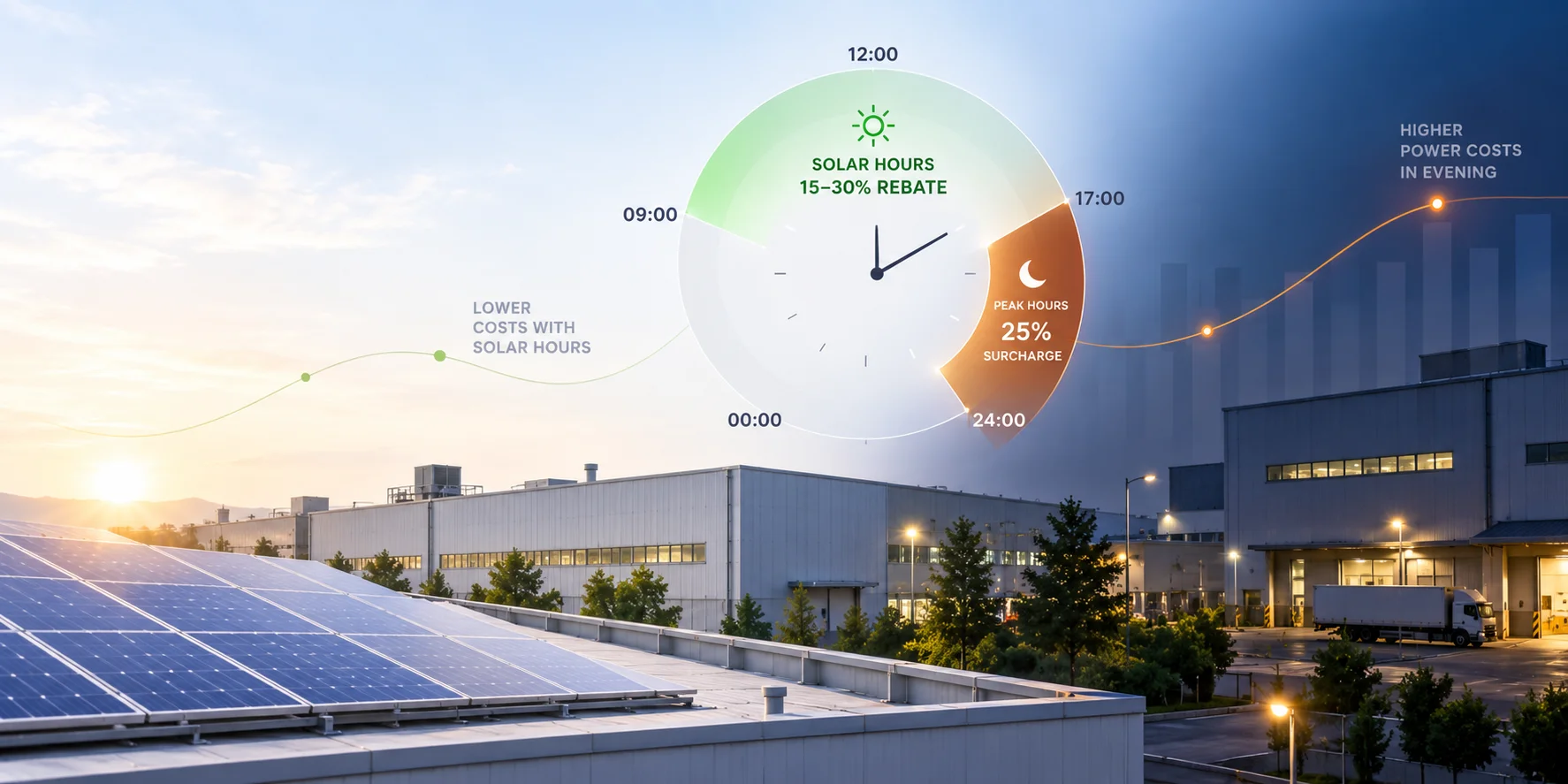
| ToD Peak Surcharge (06:00-22:00) | +20% on energy | On top of demand charge | Additional on energy units |
Source: MSEDCL Tariff Order FY 2024-25, Maharashtra Electricity Regulatory Commission (MERC)
KSEB and BESCOM follow similar demand metering structures. Karnataka’s BESCOM HT tariff applies demand charges at Rs. 310-380 per kVA depending on voltage class, with identical 15-minute interval metering. For any plant drawing more than 100 kVA of peak demand, even a 10% reduction in the recorded MD translates to five-figure monthly savings.
The excess demand provision is particularly punishing. A plant with a contracted demand of 500 kVA that inadvertently records 650 kVA in a single 15-minute interval pays the excess 150 kVA at 1.5 times the standard rate for the entire month. BESS peak shaving eliminates this scenario entirely by capping grid import at the contracted threshold.
How to Size a BESS for Peak Demand Shaving
Battery sizing for peak shaving depends on three variables derived from the plant’s load profile: the peak magnitude (kVA), the peak duration (minutes), and the peak frequency (events per day). The BESS must discharge enough energy to keep net grid import below the target set-point for the duration of each event.
Step-by-Step BESS Sizing for an Indian Industrial Plant
- Capture 15-minute demand interval data for a minimum of 30 days using a Fluke 1760 or equivalent power quality analyser. Export the data to identify peak windows, their frequency, and average duration.
- Set the target MD threshold — typically 85-90% of contracted demand to allow a buffer for measurement tolerances and utility meter rounding.
- Calculate the energy deficit for each peak event: E (kWh) = Average Power Surplus (kW) x Duration (hours). For a plant shedding 150 kW for an average of 20 minutes per event with 4 events per day, daily energy requirement = 150 x (20/60) x 4 = 200 kWh.
- Apply round-trip efficiency correction: Size battery capacity at E / 0.92 (for 92% round-trip efficiency). In the example above: 200 / 0.92 = 217 kWh usable.
- Apply DoD correction for cycle life: LFP at 80% DoD = usable / 0.80 = 271 kWh nameplate. Select the nearest standard module configuration.
- Size the PCS (inverter) power rating to the peak discharge current required, not the average. If demand spikes reach 300 kW above the threshold for 2-3 minutes, the PCS must sustain 300 kW continuous output for that window.
Q Sine’s engineering team provides full sizing documentation with the energy audit report, covering module configuration, PCS rating, BMS specifications, and integration requirements for the plant’s existing HT panel.
Quantified Benefits of BESS Peak Demand Shaving in India
The financial case for BESS in Indian industry rests on three stacked value streams: demand charge reduction, energy arbitrage via MSEDCL ToD tariff differential, and operational avoided costs from eliminating excess demand penalties.
| Value Stream | Typical Saving (per Month) | Basis |
| Demand charge reduction (25-35% MD reduction) | Rs. 50,000-1,50,000 | MSEDCL HT SC-II, 500 kVA plant |
| ToD energy arbitrage (off-peak charge / peak discharge) | Rs. 20,000-60,000 | Rs. 3.50/kWh tariff differential, 100 kWh daily |
| Excess demand penalty avoidance | Rs. 15,000-45,000 | Eliminating 3-5 MD excess events/month |
| Power factor improvement (indirect) | Rs. 8,000-20,000 | Reduced reactive current during peak window |
| Total estimated monthly saving | Rs. 93,000-2,75,000 | Combined; varies by plant load profile |
Note: Savings calculated on MSEDCL HT tariff FY 2024-25 rates. Plant-specific audit is required for an accurate projection.
Energy arbitrage compounds the demand charge saving. MSEDCL’s ToD tariff charges off-peak units (22:00-06:00) at a 20% discount relative to normal hours. A BESS programmed to charge during the off-peak window and discharge during the 06:00-22:00 window effectively buys cheap energy and avoids expensive energy, adding Rs. 1.00-1.50 per kWh of margin on every cycle.
How Peak Demand Shaving with BESS Works in Practice
A BESS operating in peak shaving mode follows a control loop that runs on a sub-second cycle. The PCS measures grid import current at the PCC on a continuous basis. When the measured import exceeds the setpoint threshold (typically set at 90% of contracted demand to allow a 10% buffer), the BMS releases stored energy and the PCS injects balanced three-phase current into the LT or HT busbars.
The injection rate is proportional control: a demand reading 50 kVA above the threshold triggers a proportional 50 kVA discharge. This avoids over-discharge and unnecessary battery cycling on minor fluctuations. The system reverts to standby as soon as the measured import falls below the threshold. If the demand spike is sustained, the BESS sustains discharge until either the event ends or the battery reaches its minimum state of charge (SOC) cut-off, typically 20% SOC.
Integration with Plant Infrastructure
Q Sine’s BESS connects to the plant’s HT/LT switchgear via a dedicated isolation transformer and LT feeder. A communication cable links the PCS controller to the plant’s existing SCADA or energy monitoring system via Modbus TCP or CANopen protocol, enabling remote SOC monitoring, event logging, and threshold adjustment without requiring physical access to the BESS enclosure. Full integration with the plant EMS allows the BESS to respond to production scheduling data, raising or lowering the shaving threshold on shift change days when demand profiles differ from normal operating patterns.
Industries Where Peak Demand Shaving Delivers the Highest Returns
Not all industrial loads produce the same peak shaving opportunity. The value of BESS scales with the ratio of peak demand to average demand (the load factor). Low load factor industries with sharp, recurring demand spikes offer the best return on BESS investment.
| Industry | Peak Trigger | Typical Demand Spike | BESS ROI Rating |
| Steel / Foundry | Electric arc furnace ramp, compressor start | 200-500 kVA, 5-15 min | Very High |
| Automobile | Transfer press, weld line cycle | 150-350 kVA, 2-8 min | High |
| Pharmaceutical | HVAC chiller start, lyophiliser | 100-250 kVA, 3-10 min | High |
| Data Centres | Server room cooling, UPS switchover test | 200-600 kVA, continuous | Very High |
| Textile | Ring frame startup, humidification system | 80-200 kVA, 5-20 min | Medium-High |
| Sugar Mills | Centrifuge start, steam turbine load | 300-800 kVA, 10-30 min | Very High (seasonal) |
Steel and foundry applications produce the most aggressive demand spikes due to electric arc furnace operations and large compressor motor starts. A Q Sine BESS installation at a Pune MIDC foundry operating a 2.5 MVA EAF consistently recorded demand peaks of 420-480 kVA above contracted demand during furnace charge loading. After BESS deployment with a 500 kWh / 400 kW PCS configuration, maximum demand recordings dropped by 38%, translating to Rs. 1.28 lakh per month in MD charge reduction alone.
BESS Peak Shaving vs. Other Demand Management Approaches
Indian plant engineers have historically managed peak demand through manual load shedding, demand controllers, or power factor correction equipment. Each approach has limitations that BESS overcomes.
| Approach | Mechanism | Limitation | BESS Advantage |
| Manual load shedding | Operator turns off non-critical loads | Requires vigilance; disrupts production | Autonomous; no production impact |
| Demand controller relay | Cuts loads when MD threshold approached | Hard-wired trip; operator override common | Proportional response; no load trips |
| PF correction (APFC/SVG) | Reduces kVAR; improves kVA reading | Does not reduce real power demand | Reduces both real and apparent demand |
| Generator peaking | DG set starts on demand event | Startup delay; fuel cost; emissions | Millisecond response; zero emissions |
| BESS peak shaving | Battery discharges to cap grid import | Higher capex; requires periodic maintenance | Fully autonomous; fastest response |
Power factor correction reduces the kVA reading on the utility meter by reducing reactive current, which is a complementary measure rather than a substitute. A plant running an APFC panel alongside a BESS extracts savings from both demand reduction (BESS) and power factor penalty avoidance (APFC) simultaneously, improving the combined ROI of the energy management investment.
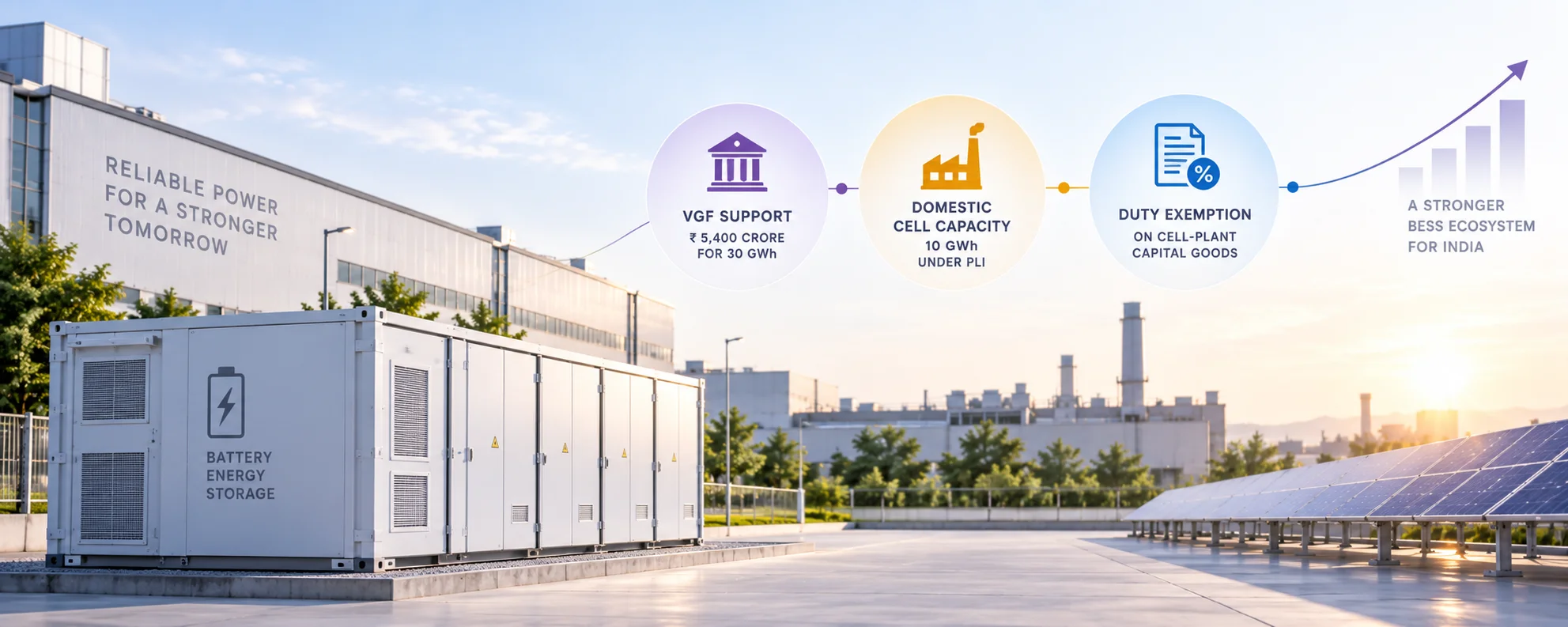
Regulatory and Subsidy Framework for BESS in India
India’s energy storage regulatory environment has evolved significantly since 2022. The Bureau of Energy Efficiency (BEE) under the Ministry of Power issued the Energy Storage Obligation (ESO) guidelines in 2023, requiring large power consumers to procure a percentage of their energy from storage-backed sources. For industrial facilities above 1 MW connected load, this creates a compliance-linked demand for BESS deployment beyond purely financial considerations.
The National Mission for Enhanced Energy Efficiency (NMEEE) provides financial incentives for energy storage installations that demonstrate measurable demand reduction, including interest subvention of up to 3% on term loans for qualifying BESS projects under the Partial Risk Guarantee Fund for Energy Efficiency (PRGFEE) scheme. Industrial consumers under MSEDCL’s HT tariff are eligible to participate in the Distribution Feeder Segregation (DFS) pilot, which compensates demand response participants for voluntary demand curtailment during grid stress events, with payments credited directly to the electricity bill.
From a depreciation standpoint, BESS qualifies for accelerated depreciation at 40% under Schedule II of the Companies Act 2013 and at 80% for systems used in energy conservation under the Income Tax Act, providing a significant tax benefit in the first two years post-commissioning that improves project IRR materially.
What to Look for in a BESS Supplier in India
Industrial BESS procurement in India is complicated by a market that includes cell importers, system integrators, and full-scope manufacturers. The distinctions matter significantly for long-term performance and warranty coverage.
- Battery chemistry verification: Insist on third-party cell test certificates confirming LFP or NMC chemistry, cycle life rating (minimum 3,000 cycles at 80% DoD), and UN 38.3 transport testing certification.
- PCS topology: Demand peak shaving requires a PCS with sub-20ms response time. Confirm this specification in writing, not just in the brochure.
- BMS integration: The BMS must communicate state of health (SOH), state of charge (SOC), cell-level temperature, and fault diagnostics to an accessible SCADA interface. Systems without remote monitoring require on-site visits for routine diagnostics.
- Warranty structure: Industry standard is a 5-year system warranty with an 80% capacity retention guarantee at the end of the warranty period. Anything below this should be scrutinised.
- Local service capability: Battery systems require periodic cell balancing, coolant top-up, and BMS firmware updates. Suppliers without pan-India service teams create operational risk for manufacturing plants that cannot afford unplanned downtime.
Q Sine maintains factory-trained service teams across Pune, Nashik, Mumbai, Bengaluru, and Chennai, covering the industrial corridors where the majority of India’s HT-billed manufacturing load is concentrated.
Conclusion
Peak demand shaving with BESS represents the most financially direct path to reducing industrial electricity costs in India for plants where demand charges constitute 35-55% of the total bill. Unlike energy efficiency measures that require process changes or capital-intensive equipment upgrades, BESS operates transparently at the utility metering point, delivering savings on the next bill cycle after commissioning.
The financial case is built on three stacked streams: MD charge reduction (25-40%), ToD energy arbitrage (Rs. 1.00-1.50/kWh margin) and avoided excess demand penalties. Regulatory tailwinds from BEE’s Energy Storage Obligation, PRGFEE interest subvention, and 80% accelerated depreciation compress payback periods to 3-5 years for well-sized systems at Indian industrial tariffs.
Q Sine Energy Solutions is a Pune-based power quality and energy management manufacturer with 30+ years of experience and 550+ installations across India. Q Sine engineers BESS systems that integrate bidirectional PCS technology with LFP battery chemistry, BMS communications, and full energy audit-backed sizing to deliver peak shaving deployments that meet MSEDCL, KSEB, and BESCOM tariff requirements. Explore battery energy storage solutions from Q Sine, or read how the Cost-Benefit Analysis of BESS compares system economics across different industrial load profiles.
Q1: What is peak demand shaving with BESS and how does it reduce electricity bills in India?
Peak demand shaving with BESS reduces the maximum demand (kVA) recorded on the utility meter during any 15-minute interval in a billing cycle, directly lowering the demand charge component of the electricity bill. MSEDCL HT tariff SC-II levies Rs. 300-370 per kVA per month on the highest recorded demand; a 200 kVA reduction saves Rs. 60,000-74,000 per month before energy arbitrage is counted.
Q2: How much battery capacity (kWh) is required for peak demand shaving in an Indian manufacturing plant?
Battery capacity for peak demand shaving is sized on peak magnitude (kW above threshold), peak duration (minutes), and daily event frequency. A plant with 150 kW demand spikes lasting 20 minutes on average, occurring 4 times per day, requires approximately 217 kWh usable capacity (150 kW x 20 min x 4 events / 60 / 0.92 efficiency).
Q3: What is the payback period for a BESS used for peak demand shaving in India?
BESS payback periods for peak demand shaving in Indian industry typically range from 3-5 years when combining demand charge reduction, MSEDCL ToD tariff energy arbitrage, and accelerated depreciation benefits under the Income Tax Act. A 500 kWh / 400 kW BESS installation costing Rs. 1.8-2.2 crore can generate Rs. 1.2-2.0 lakh per month in combined savings, yielding a simple payback of 40-55 months.
Q4: Does MSEDCL allow BESS installations for demand reduction under current regulations?
MSEDCL permits BESS installations for demand management under the Distribution Open Access provisions and CEA Technical Standards for Connectivity to the Grid (Amendment 2023). There is no restriction on C&I consumers installing behind-the-meter BESS systems for demand charge reduction.
Q5: Which Indian industries benefit most from BESS peak demand shaving?
Steel foundries, data centres, automobile component manufacturers, and pharmaceutical cleanrooms show the highest BESS peak shaving returns due to sharp, high-amplitude, recurring demand spikes from electric arc furnaces, cooling system compressors, transfer press cycles, and HVAC chillers.
References
[1] Maharashtra Electricity Regulatory Commission (MERC) (2024). MSEDCL Tariff Order FY 2024-25. MERC Order No. 3 of 2024. merc.gov.in
[2] Bureau of Energy Efficiency (BEE), Ministry of Power, Government of India (2023). Energy Storage Obligations: Guidelines for Large Industrial Consumers. BEE Publication. beeindia.gov.in
[3] Central Electricity Authority (CEA), Government of India (2023). Technical Standards for Connectivity to the Grid (Amendment). Ministry of Power, New Delhi. cea.nic.in
[4] CATL (Contemporary Amperex Technology Co. Ltd.) (2024). LFP Battery Module Performance Specifications: Cycle Life and Capacity Retention Data. CATL Technical Data Sheet DS-LFP-280Ah. catl.com
[5] National Mission for Enhanced Energy Efficiency (NMEEE), BEE (2023). Partial Risk Guarantee Fund for Energy Efficiency (PRGFEE): Eligibility and Application Guidelines for Industrial Energy Storage Projects. beeindia.gov.in
[6] IEEE (2018). IEEE 1547-2018: Standard for Interconnection and Interoperability of Distributed Energy Resources with Associated Electric Power Systems Interfaces. IEEE Standards Association. standards.ieee.org
[7] Bureau of Indian Standards (BIS) (2014). IS 16270:2014: Stationary Lead Acid Batteries (and extensions covering LFP chemistry, 2022 amendment). BIS, New Delhi. bis.gov.in
Continue Reading
Get free access to this article and stay updated with Q Sine's latest insights on power quality and energy solutions. No spam, ever.
You're in!
Unlocking the full article now…
Your details are safe. We never share or sell your data.