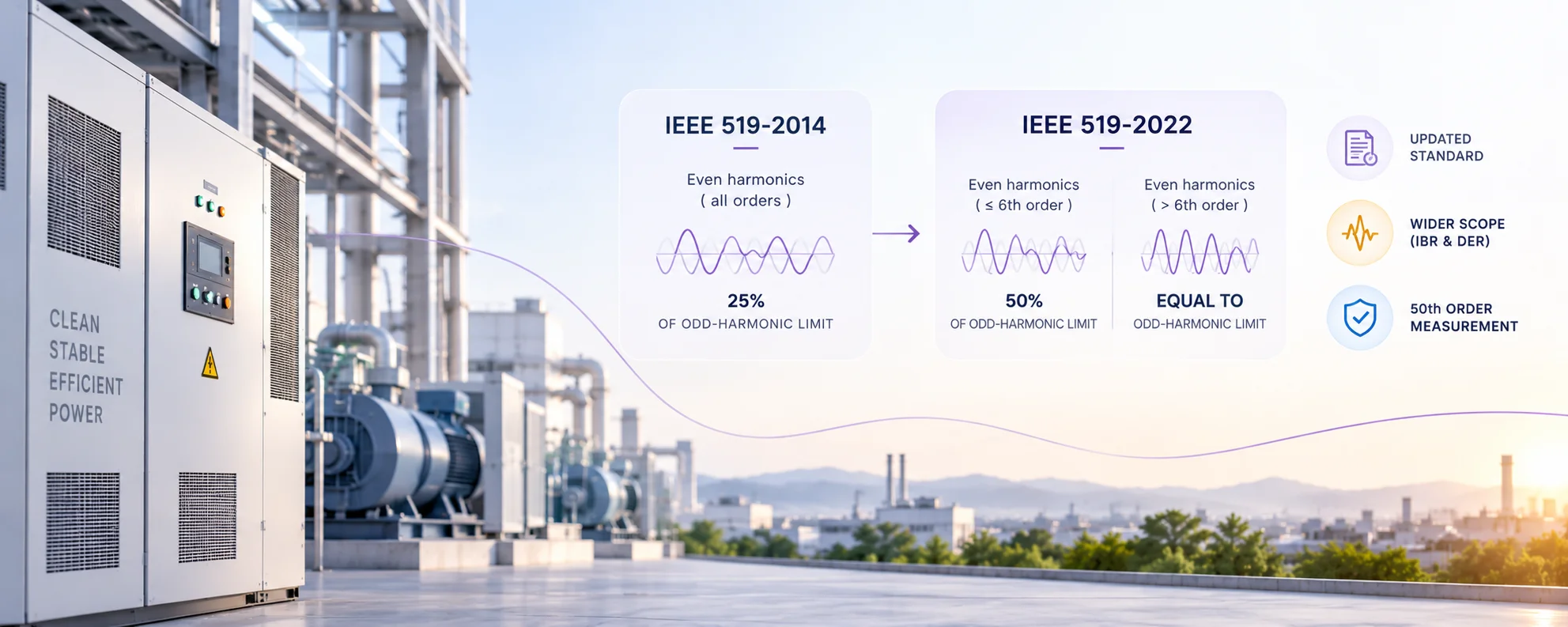
Q Sine Energy Solutions Pvt. Ltd is a Pune-based ISO 9001:2015-certified power quality and energy management manufacturer with 550+ installations across India. IEEE 519-2022 replaced IEEE 519-2014 in August 2022, and its biggest change relaxes even-order harmonic current limits. The 2022 edition lets even harmonics above the 6th order equal the odd-harmonic limit, unlike the uniform 25% cap in 2014. A compliance report still citing IEEE 519:2014 references a superseded standard and can flag compliant equipment as a violation. CEA’s Technical Standards for Connectivity to the Grid Regulations bind Indian PCC harmonic limits to IEEE 519, as amended, from time to time. That clause pulls IEEE 519-2022 into force even where compliance paperwork still names the 2014 edition. This guide sets out exactly what changed and what your compliance report needs to update.
KEY TAKEAWAYS
- IEEE 519-2022 replaced IEEE 519-2014 in August 2022 as the current benchmark for harmonic control.
- Even harmonics above the 6th order can now equal odd-harmonic limits, up to 4x the 2014 ceiling.
- TDD and individual odd-harmonic limits in Tables 2 through 4 are numerically unchanged from 2014.
- CEA’s Connectivity Regulations bind Indian PCC harmonic limits to IEEE 519, as amended, from time to time.
Compliance measurement now covers harmonics up to the 50th order on Class A instruments.
What Actually Changed Between IEEE 519-2014 and IEEE 519-2022?
IEEE 519-2022 relaxed even-order current harmonic limits, replaced should with shall throughout the compliance language, extended scope to inverter-based and distributed energy resources, and added a decision tree for applying limits at the point of common coupling. Voltage distortion limits and the individual odd-harmonic and TDD figures in Tables 2 through 4 remain numerically identical to 2014.
The 2014 edition capped every even harmonic at 25% of the odd-harmonic limit in its group, with no exception by order. The 2022 edition splits that rule: even harmonics at or below the 6th order stay capped at 50% of the table limit, while even harmonics above the 6th order face no separate ceiling and can equal the full odd-harmonic figure. The comparison below summarises the changes that affect a compliance report.
| Element | IEEE 519-2014 | IEEE 519-2022 |
| Document status | Recommended Practice | Standard (“shall”, mandatory) |
| Even harmonics, 6th order or below | 25% of odd-harmonic limit | 50% of odd-harmonic limit |
| Even harmonics above the 6th order | 25% of odd-harmonic limit | Equal to odd-harmonic limit, no separate cap |
| TDD and odd-harmonic limits (Tables 2 to 4) | Baseline values | Unchanged from 2014 |
| IBR and DER scope | Not addressed | Decision tree added for PCC application |
| Measurement extent | Not explicit | 50th harmonic order, Class A instruments |
Why Do Relaxed Even-Harmonic Limits Matter for an Indian Plant?
Even-order harmonics come from waveform asymmetry, and IBR inverters, active front ends, and active harmonic filter controllers generate more of them than the diode rectifiers the 2014 table was written around. A plant audited against the 2014 even-harmonic ceiling can show a false violation on equipment that is fully compliant under 2022 limits.
A harmonic study report that still tests even orders above the 6th against the old 25% figure will overstate distortion on any AHF, SVG, or VFD installation with an active front end. That misreading can trigger unnecessary derating, a rejected connectivity application, or a disputed DISCOM penalty on power that was never out of limits. Plants correcting both harmonics and power factor together should review Q Sine’s reactive power management solutions before re-testing against the 2022 limits.
Does IEEE 519-2022 Already Apply Under Indian Regulations?
Yes. CEA’s Technical Standards for Connectivity to the Grid Regulations state that current harmonic limits at the point of common coupling shall be in accordance with IEEE 519-2014 standards, as amended, from time to time. That wording incorporates the 2022 revision automatically, without a fresh CEA notification naming it.
Most compliance certificates, power quality audit reports, and connectivity applications filed with MSEDCL and other DISCOMs across India still cite IEEE 519:2014 by name, a citation that was accurate before August 2022 and is now incomplete. A plant relying on the incorporation-by-reference clause should still update its documentation to name IEEE 519-2022 directly, since an auditor or DISCOM engineer working from the newer tables will expect the same reference.
What is the main difference between IEEE 519-2014 and IEEE 519-2022?
The main difference is the even-harmonic current limit. IEEE 519-2014 capped every even harmonic at 25% of the matching odd-harmonic figure. IEEE 519-2022 keeps a 50% cap only up to the 6th order and removes the ceiling above it, letting those harmonics equal the odd-harmonic limit.
Voltage limits, TDD bands, and odd-harmonic figures are unchanged, so a plant’s harmonic mitigation strategy stays the same; only the compliance table it is measured against has changed. See Q Sine’s reactive power management solutions for the equipment side of that strategy.
Is IEEE 519-2014 still valid for compliance reports in India?
No. IEEE 519-2022 replaced IEEE 519-2014 as the current edition in August 2022, and CEA’s connectivity regulations bind Indian PCC harmonic limits to IEEE 519 as amended from time to time, pulling the newer edition into force by reference at every point of common coupling.
A report still naming IEEE 519:2014 is not necessarily wrong on the odd-harmonic numbers, since those are unchanged, but it cites a superseded document and should be corrected at renewal. Related reading: Meeting IEEE 519 Standards with Modern Solutions.
Up to which harmonic order must a compliance measurement extend?
IEEE 519-2022 clarifies that harmonic measurement for compliance must extend up to the 50th order using Class A instruments under IEC 61000-4-30, the same instrument class CEA’s connectivity regulations already require today for Indian installations connected at 11kV or above.
Confirming instrument class and Q Sine’s Active Harmonic Filter commissioning data before a power quality audit avoids a report that under-measures high-order harmonics and misses a real compliance gap.
References
1. IEEE Standards Association. IEEE Std 519-2022, “IEEE Standard for Harmonic Control in Electric Power Systems”. Board Approval 2022-05-13, Published: 2022-08-05. Supersedes IEEE 519-2014. standards.ieee.org/ieee/519/10677
2. IEEE Xplore. “IEEE Std 519-2022: IEEE Standard for Harmonic Control in Electric Power Systems”, Table 2 (current distortion limits, systems 120V through 69kV) and h ≤ 6 even-harmonic footnote. ieeexplore.ieee.org/document/9848440
3. Central Electricity Authority, Government of India. Technical Standards for Connectivity to the Grid Regulations (as amended), Power Quality standards clause: current harmonic limits at PCC “shall be in accordance with the IEEE 519-2014 standards, as amended, from time to time.” cea.nic.in: Connectivity to the Grid (Amendment) Regulations, 2019
4. Mirus International Inc. “IEEE Std 519-2022 Update and Changes From Prior Version (2014).” Application note detailing even-harmonic limit relaxation and the 50th-order / Class A measurement clarification. mirusinternational.com application note
Continue Reading
Get free access to this article and stay updated with Q Sine's latest insights on power quality and energy solutions. No spam, ever.
You're in!
Unlocking the full article now…
Your details are safe. We never share or sell your data.