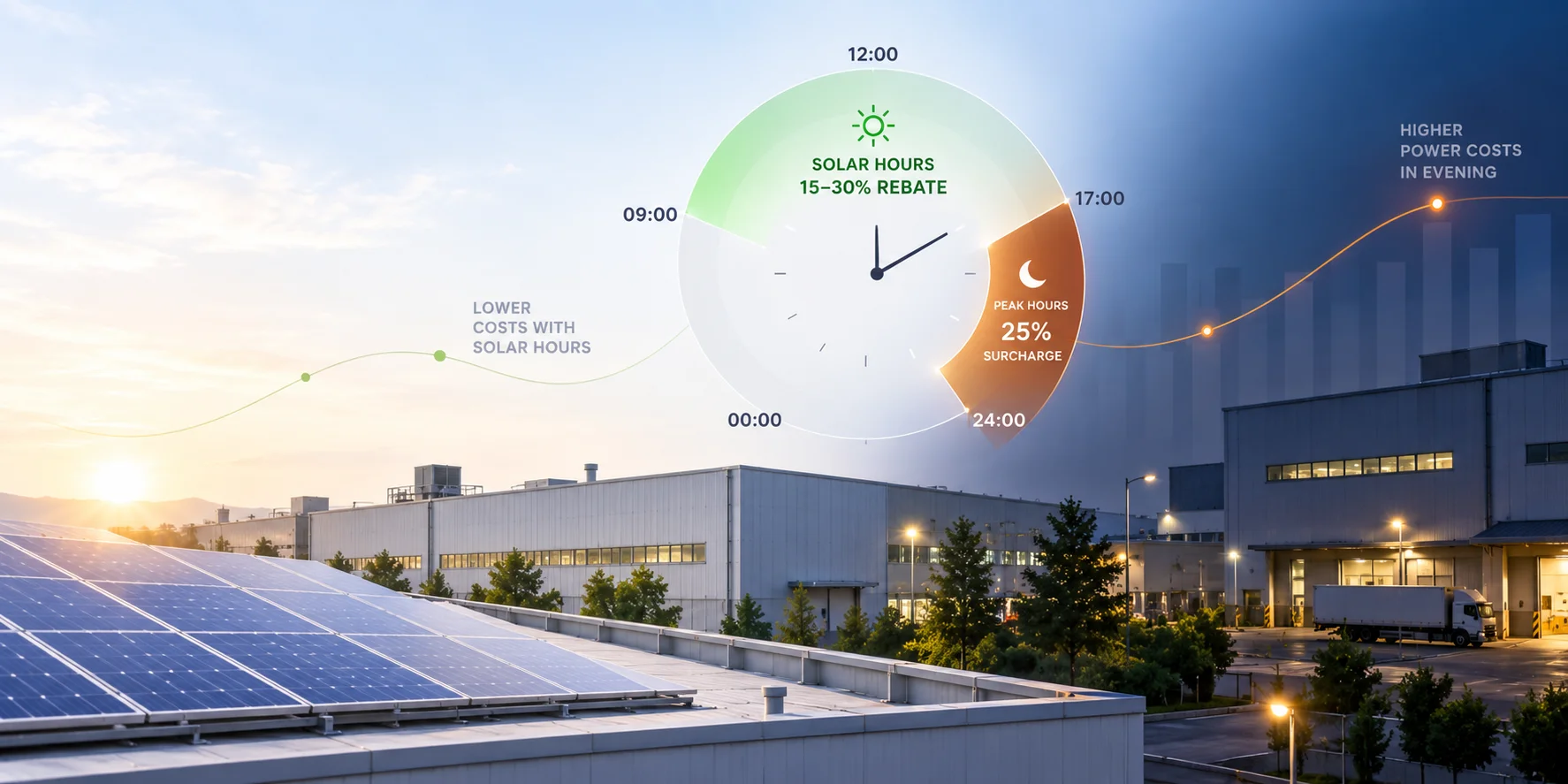
Q Sine Energy Solutions Pvt. Ltd. is a Pune-based ISO 9001:2015 certified power quality and energy management manufacturer with 550+ installations across India. The MERC 2026 tariff order, Case No. 75 of 2025, finalised 25 March 2026, confirms a redesigned Time of Day tariff for MSEDCL. HT and LT Industrial and Commercial consumers now pay a 25% surcharge on energy charges during peak hours, 17:00 to 24:00. The surcharge pushes evening load toward the day, since power costs rise once solar output falls. A plant running a shift past 5pm can see close to half its energy charge billed at the higher rate. The order also confirms a 15 to 30% solar-hour rebate, 9:00 to 17:00, effective from 1 July 2025. This guide quantifies the surcharge on a worked HT bill and shows how to cut it.
Key Takeaways
- The MERC 2026 tariff order, Case No. 75 of 2025, final 25 March 2026, sets a 25% ToD peak surcharge for HT/LT Industrial and Commercial consumers.
- Peak hours run 17:00 to 24:00. Solar hours, 9:00 to 17:00, carry a 15 to 30% rebate.
- Tariffs apply retroactively from 1 July 2025, with no sudden change for billed consumers.
- A two-shift plant past 5pm can pay 20 to 25% more on peak-window units.
- Reactive power correction and battery peak shifting both cut exposure without cutting output.
What does the MERC 2026 tariff order change?
MERC’s order in Case No. 75 of 2025 confirms the redesigned Time of Day structure for MSEDCL’s 5th Control Period, FY 2025-26 to FY 2029-30. HT and LT Industrial and Commercial consumers pay a 25% surcharge on energy charges during peak hours, 17:00 to 24:00, and earn a rebate during solar hours, 9:00 to 17:00.
The order traces back to MSEDCL’s original tariff order of 28 March 2025. MERC stayed it, revised it on 25 June 2025, and reached final resolution on 25 March 2026 after Bombay High Court-directed proceedings. Tariffs apply retroactively from 1 July 2025, so consumers already billed under interim rates see no sudden change. Other categories, except Residential, Group Housing, and Agriculture, carry a 20% peak surcharge rather than 25%. This post updates Q Sine’s MSEDCL ToD Tariff Guide, which covered the interim structure.
| Time of Day Slot | Hours | Rate Adjustment on Energy Charge |
| Peak hours | 17:00 to 24:00 | +25% HT/LT Industrial and Commercial; +20% other categories |
| Solar hours | 09:00 to 17:00 | -15% to -30% rebate, rising by year and season |
| Normal hours | 00:00 to 09:00 | No ToD adjustment |
Table 1: MERC’s redesigned ToD structure for MSEDCL LT/HT Industrial and Commercial consumers, per Case No. 75 of 2025.
How much does the peak surcharge cost a typical HT industrial plant?
The surcharge adds 25% to the energy charge for every unit billed inside the 17:00 to 24:00 window, on top of the base HT rate. A plant running an evening shift from 17:00 to 22:00 draws its full shift load at the surcharged rate, with no offsetting rebate in that period.
Consider a 1 MVA HT plant running two shifts, 08:00 to 24:00, with a roughly even load profile. About seven of its sixteen operating hours, close to 44% of daily consumption, fall inside the peak window. On a monthly energy charge of INR 12 lakh, that exposure adds roughly INR 1.3 lakh a month at the 25% premium, before fixed charges and duty. The exact figure depends on contract demand and load curve.
A power quality audit turns this from an estimate into an exact number by measuring the load profile against MSEDCL’s ToD slots.
How can a Maharashtra factory reduce exposure to the peak surcharge?
Two levers work without cutting production. Shifting battery-stored load into the peak window avoids the surcharge directly, and correcting power factor reduces the kVAh units it is calculated on, since HT billing runs on kVAh, not kWh.
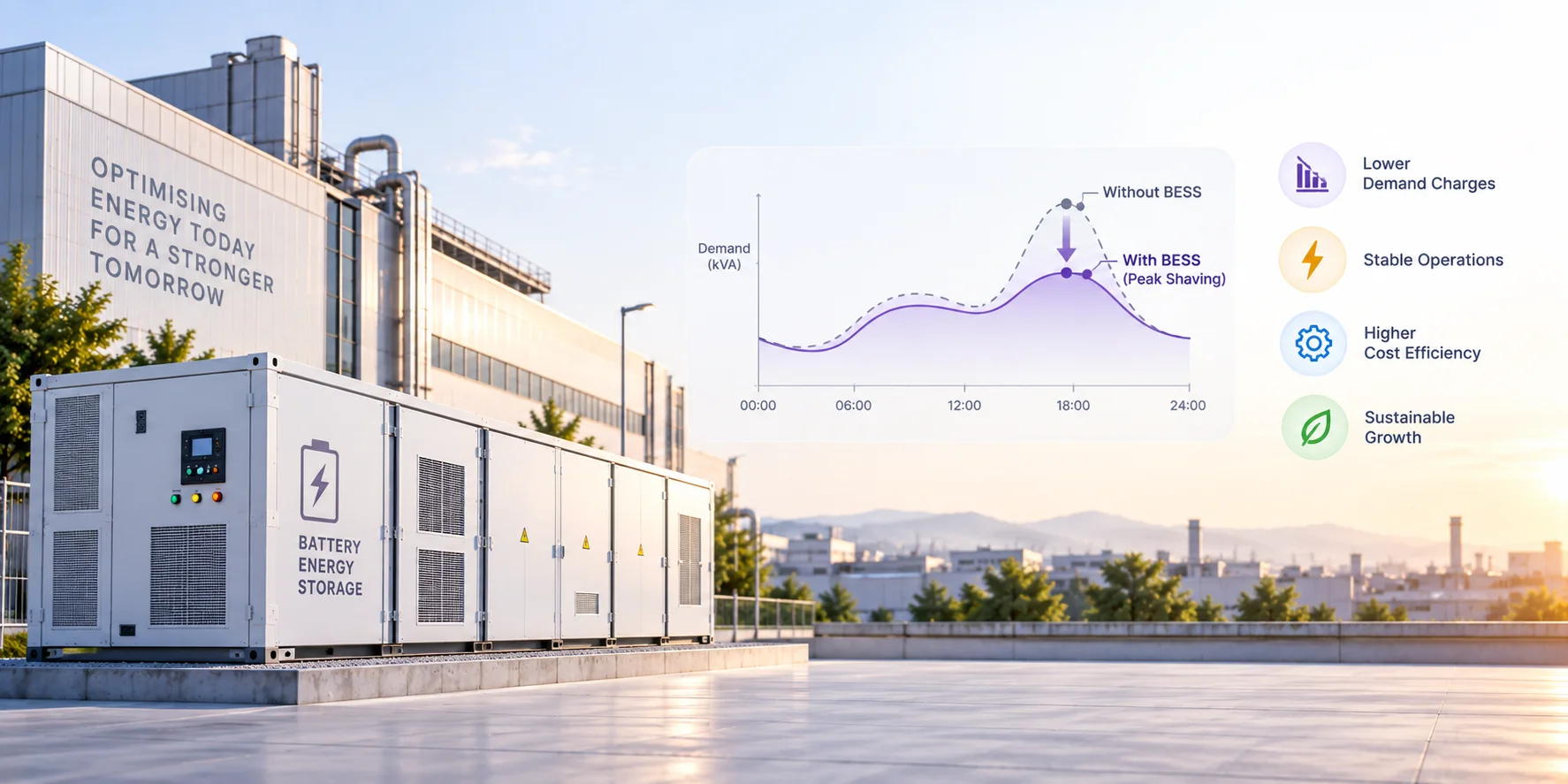
Battery storage charges during the solar-hour rebate window, 9:00 to 17:00, and discharges through the 17:00 to 24:00 peak window, covering compressor cycling, HVAC, and other flexible loads. This turns hours that would sit at a 25% premium into hours covered by stored, rebated energy. A poor power factor further inflates the kVAh units the surcharge applies to, on top of the standard MSEDCL power factor penalty. Q Sine’s reactive power management solutions correct power factor at the point of common coupling, cutting billed kVAh across every ToD slot.
What are MERC’s ToD peak and solar hours for Maharashtra industrial consumers?
Under MERC’s Case No. 75 of 2025 order, peak hours run 17:00 to 24:00 and solar hours run 9:00 to 17:00. HT and LT Industrial and Commercial consumers pay a 25% peak surcharge and earn a 15 to 30% solar-hour rebate.
The remaining hours, roughly 00:00 to 09:00, bill at the normal rate. See Q Sine’s MSEDCL ToD Tariff Guide for the full slot breakdown across categories.
Does the 25% surcharge apply to LT industrial consumers or only HT?
Both. MERC’s order applies the 25% peak surcharge equally to LT and HT Industrial and Commercial consumers. Other categories, except Residential, Group Housing, and Agriculture, carry 20% instead.
HT consumers bill on kVAh, so a poor power factor compounds the surcharge. Q Sine’s reactive power management solutions address that exposure.
What can a factory do to reduce its exposure to the peak surcharge?
Shift flexible and battery-backed load out of the 17:00 to 24:00 window. Charging a battery during the solar-hour rebate and discharging through the evening peak avoids the surcharge on that consumption entirely.
Sizing the system to the evening shift load, not the full connected load, keeps payback realistic. Q Sine’s industrial battery storage systems size against actual peak draw.
REFERENCES
1. Maharashtra Electricity Regulatory Commission. Press Note, MSEDCL Multi Year Tariff Order, redesigned Time of Day tariff structure.
https://merc.gov.in/wp-content/uploads/2025/03/Press-Note_MSEDCL-MYT-Order_English.pdf
2. Maharashtra State Electricity Distribution Co. Ltd. Order, Case No. 75 of 2025 (Review of MYT Order, Case No. 217 of 2024).
https://www.mahadiscom.in/consumer/wp-content/uploads/2025/06/Order_Case-No.75-of-2025.pdf
3. Maharashtra State Electricity Distribution Co. Ltd. Tariff Details. https://www.mahadiscom.in/en/consumer/tariff-details/
4. IEEE Standards Association. IEEE 519-2022, Recommended Practice and Requirements for Harmonic Control. https://standards.ieee.org
5. SolarQuarter. MERC Issues Final Order On MSEDCL Tariff Review After Court Intervention, 27 March 2026. https://solarquarter.com/2026/03/27/merc-issues-final-order-on-msedcl-tariff-review-after-court-intervention/
Continue Reading
Get free access to this article and stay updated with Q Sine's latest insights on power quality and energy solutions. No spam, ever.
You're in!
Unlocking the full article now…
Your details are safe. We never share or sell your data.