Q Sine Energy Solutions LLP manufactures reactive power compensation equipment, including APFC panels, RTPFC panels, and Static Var Generators for industrial facilities across India.
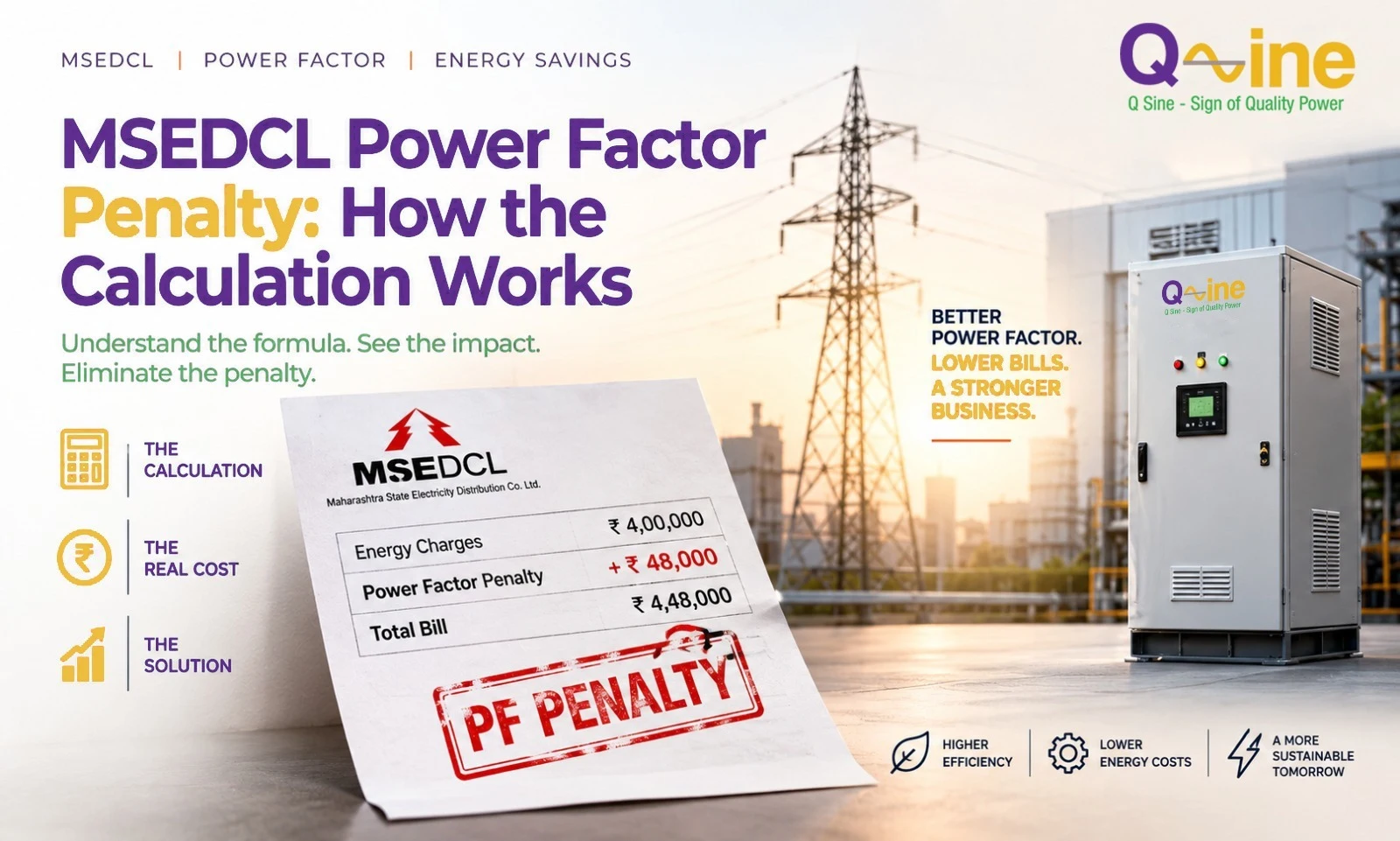
MSEDCL power factor penalty is a surcharge applied on energy bills when the average power factor at the consumer’s metering point falls below the category-specific threshold defined in the current tariff order. For HT consumers connected at 11 kV and above, MSEDCL sets that threshold at 0.95. The penalty rate is 1% of the monthly energy charges for every 0.01 below this benchmark, up to a maximum of 15%. MSEDCL calculates power factor from recorded kWh and kVAh data at the metering point, typically over a 30-day billing cycle. A plant running at PF 0.85 on a monthly energy bill of Rs. 4 lakh will pay Rs. 48,000 in surcharges per month, adding Rs. 5.76 lakh in annual penalty charges before any demand charges are considered. Sustained correction to PF 0.97 eliminates the penalty and qualifies for a 2% incentive rebate, converting a liability of Rs. 48,000 into a net monthly saving of Rs. 56,000.
Key Takeaways
- MSEDCL applies a 1% surcharge on energy charges for every 0.01 drop in power factor below the category threshold. HT consumers face a 0.95 benchmark; LT consumers face a 0.90 benchmark.
- A manufacturing plant running at PF 0.85 on a monthly energy bill of Rs. 4 lakh pays Rs. 40,000 in penalties under the HT-I tariff, totalling Rs. 4.8 lakh per year.
- MSEDCL also offers a 1% rebate per 0.01 improvement above the threshold, up to PF 1.0. Maintaining PF 0.99 generates both penalty avoidance and positive incentives.
- Q Sine’s APFC Panel corrects static reactive demand with capacitor banks; the Static Var Generator (SVG) handles dynamic loads with sub-5ms response. Both eliminate the MSEDCL penalty in sustained operation.
- Payback on an APFC installation is typically 6 to 14 months, depending on the load profile and the monthly penalty quantum. SVG payback extends to 18-24 months but covers fluctuating loads that APFC cannot handle.
How MSEDCL Structures the PF Penalty and Incentive
The penalty and incentive mechanism appear in MERC’s tariff orders and is administered by MSEDCL for all LT and HT consumers in Maharashtra. The structure is straightforward, but many plant electrical teams misread it when calculating exposure.
| Category | PF Threshold | Penalty Rate | Max Penalty | Incentive |
| HT Category (11 kV+) | 0.95 | 1% per 0.01 below | 15% of energy charges | 1% per 0.01 above 0.95 |
| LT Category (below 11 kV) | 0.90 | 1% per 0.01 below | 15% of energy charges | 1% per 0.01 above 0.90 |
Source: MERC Tariff Order for MSEDCL (applicable tariff year). HT-I category shown. Confirm current rates against your active tariff schedule.
Power factor is computed from kWh and kVAh import readings at the TOD-compliant smart meter. The formula in effect is: PF = kWh / kVAh. MSEDCL meters record both values continuously; the billed PF is the ratio of total kWh to total kVAh over the billing period. A plant cannot argue a spot-reading exception: the penalty applies to the integrated monthly average.
Worked Example: PF 0.83 vs PF 0.97 on a Rs. 4 Lakh Bill
The table below compares two scenarios for an HT-I consumer at 11 kV with a monthly energy charge of Rs. 4,00,000, measured average PF of 0.83 without correction and 0.97 after installing a Q Sine APFC panel.
| Parameter | Scenario A: No Correction | Scenario B: APFC Installed |
| Monthly Energy Charges | Rs. 4,00,000 | Rs. 4,00,000 |
| Measured PF (avg) | 0.83 | 0.97 |
| PF Threshold (HT-I) | 0.95 | 0.95 |
| PF Shortfall | 0.12 (12 steps × 1%) | 0 (above threshold) |
| PF Surcharge | Rs. 48,000 (12%) | Rs. 0 |
| PF Incentive | — | Rs. 8,000 (2% for 0.97) |
| Effective Monthly Bill | Rs. 4,48,000 | Rs. 3,92,000 |
| Annual Penalty / Saving | Penalty: Rs. 5,76,000 | Saving: Rs. 56,000 + Rs. 48,000 = Rs. 6,32,000 |
The annual delta between the two scenarios is Rs. 6,32,000. A Q Sine APFC Panel sized for this load profile typically costs between Rs. 3.5 lakh and Rs. 6 lakh depending on kVAr requirement, giving a payback period of 7 to 12 months purely on MSEDCL penalty recovery, before factoring in reduced transformer loading and lower kVAh-based charges.
APFC Panel vs Static Var Generator: Which Eliminates the Penalty
Both technologies bring power factor to the target range, but they operate differently. The correct choice depends on load characteristics, not cost alone.
| Parameter | APFC Panel | Static Var Generator (SVG) |
| Response Time | 50–200 ms (contactor switching) | < 5 ms (IGBT-based) |
| Load Suitability | Steady, slowly varying loads | Fluctuating, cyclic, arc loads |
| Harmonic Environment | Requires detuned reactors with harmonics present | Immune to harmonics; no detuning needed |
| kVAr Range | 25 kVAr to 1,000 kVAr per panel | 50 kVAr to 1,000 kVAr per module |
| Penalty Elimination | Yes, for constant-load plants | Yes, for dynamic-load plants |
| Typical Payback | 6–14 months | 18–24 months |
For plants with press shops, induction furnaces, or arc welding operations where load fluctuates within seconds, an SVG prevents the rapid reactive demand spikes that APFC contactors cannot track. For plants with centrifugal pumps, compressors, and air handling units running at near-constant load, APFC delivers the same PF result at substantially lower capital cost.
Frequently Asked Questions
What is the MSEDCL power factor penalty formula?
MSEDCL calculates PF as kWh divided by kVAh at the billing meter. For every 0.01 that the monthly average PF falls below the threshold (0.95 for HT-I, 0.90 for LT), MSEDCL applies a 1% surcharge on energy charges, up to 15%.
Does MSEDCL give a rebate if power factor exceeds the threshold?
Yes. MSEDCL offers a 1% incentive rebate on energy charges for every 0.01 improvement above the threshold. An HT-I consumer at PF 0.99 receives a 4% rebate (0.99 minus 0.95 = 4 steps). PF 1.0 or unity earns the maximum incentive under the applicable tariff order.
How does MSEDCL measure power factor for billing?
MSEDCL meters record cumulative kWh and kVAh import values. Billing PF equals total kWh divided by total kVAh over the billing period, typically 30 days. This is a monthly average, not a peak or spot reading.
Can an APFC panel eliminate MSEDCL penalty entirely?
An APFC panel eliminates MSEDCL penalty for plants with steady or slowly varying loads. For plants with high-frequency load fluctuations such as arc furnaces, presses, or resistance welders, an SVG or hybrid system is required to hold PF above the threshold consistently.
References
Maharashtra Electricity Regulatory Commission (MERC) — Tariff Orders for MSEDCL (current applicable year). Available at: merc.gov.in
MSEDCL Tariff Schedule — HT and LT Category Definitions, Penalty and Incentive Clauses. Available at: mahadiscom.in
Q Sine Energy Solutions — Reactive Power Management Solutions. qsine.co.in/solutions/reactive-power-management-solutions/
Q Sine Energy Solutions — APFC Panel Product Page. qsine.co.in/products/apfc-panel/
Q Sine Energy Solutions — Static Var Generator Product Page. qsine.co.in/products/static-var-generator/
Continue Reading
Get free access to this article and stay updated with Q Sine's latest insights on power quality and energy solutions. No spam, ever.
You're in!
Unlocking the full article now…
Your details are safe. We never share or sell your data.