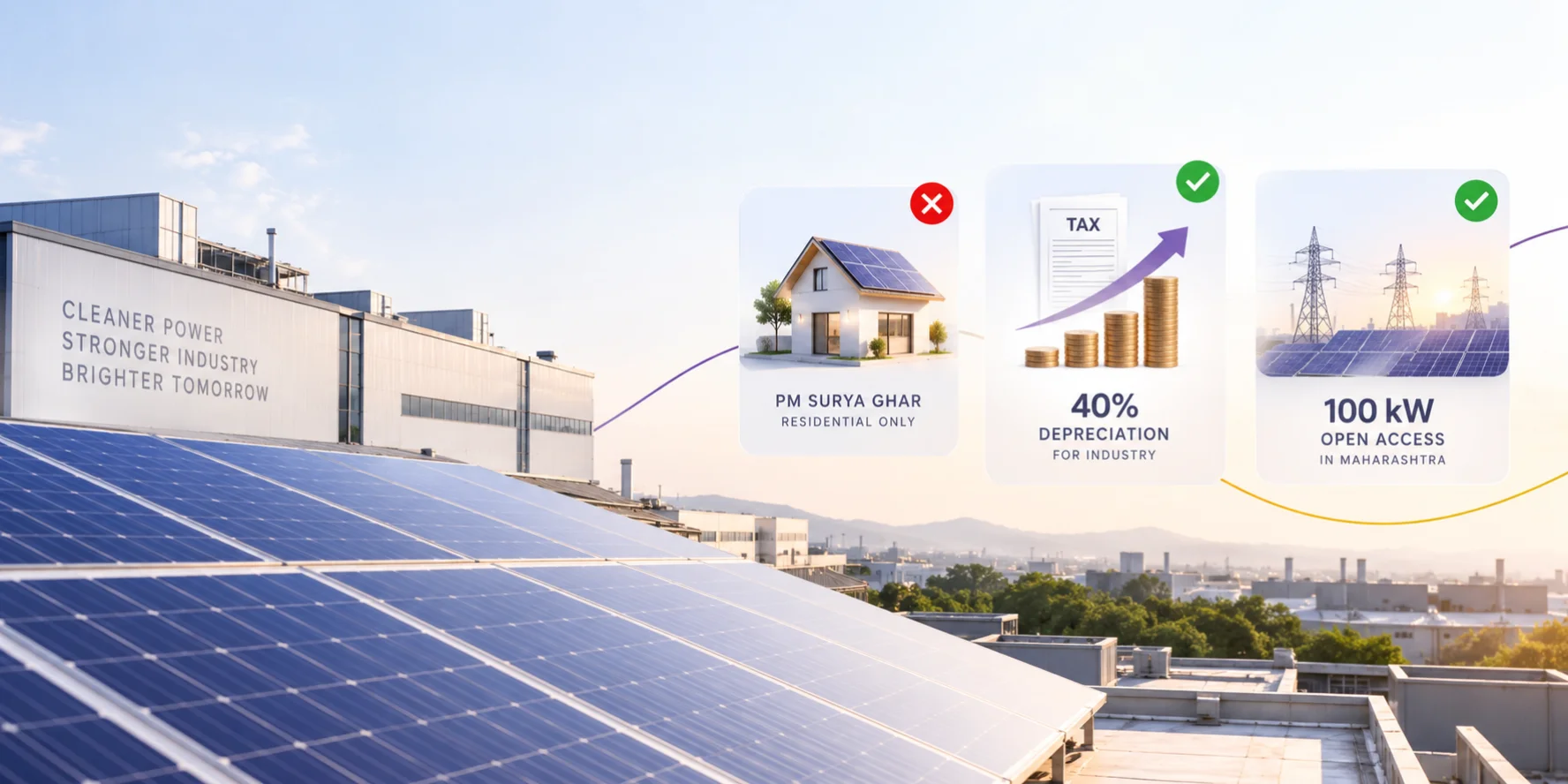
Q Sine Energy Solutions Pvt. Ltd is a Pune-based ISO 9001:2015-certified power quality and energy management manufacturer with 550+ installations across India. The PM Surya Ghar Muft Bijli Yojana does not apply to industrial or commercial consumers; it is a residential-only rooftop subsidy. The Press Information Bureau confirms the scheme covers residential DISCOM connections only, with no industrial or commercial provision. A plant head chasing that scheme loses ground against two levers built for industry instead: tax depreciation and open access. The income tax rules place solar power-generating systems in a 40% year-1 depreciation block, far above ordinary plant and machinery. Maharashtra’s Green Energy Open Access threshold now sits at 100 kW of sanctioned load, not the older 1 MW mark. This post separates the residential scheme from the levers that actually apply to a factory roof.
Key Takeaways
- PM Surya Ghar is residential-only; factories and commercial units cannot claim its subsidy.
- Solar assets get 40% Year-1 depreciation under Income Tax Rules Appendix I, versus 15% for ordinary machinery.
- Maharashtra’s Green Energy Open Access threshold is 100 kW of sanctioned load, not the earlier 1 MW limit.
- Captive generation needs 26% equity and 51% consumption to waive the cross-subsidy surcharge.
- An energy audit identifies which lever suits a plant’s actual load profile.
Why Doesn’t PM Surya Ghar Apply to Industrial Solar Buyers?
The PM Surya Ghar Muft Bijli Yojana is a residential rooftop solar subsidy administered by the Ministry of New and Renewable Energy through DISCOM connections. The Press Information Bureau’s own scheme description limits it to residential consumers with a household electricity connection. No commercial, industrial, or HT connection qualifies for the Central Financial Assistance, regardless of rooftop area or intent.
PM Surya Ghar dominates search results, and Maharashtra alone recorded 391,887 installations and Rs 2,787.59 crore disbursed by December 2025, a scale that makes plant heads assume an industrial channel exists. It does not. Registration runs through a household DISCOM account on the National Portal, with no field for a commercial or HT industrial consumer number. A factory that applies anyway gets rejected at the eligibility check.
How Much Can a Factory Save Through Accelerated Depreciation?
Solar power generating systems sit inside the 40% year-1 depreciation block under Appendix I of the Income Tax Rules, against 15% for ordinary plant and machinery. On a Rs 3.5 crore rooftop or ground-mount installation, that first-year written-down value claim shrinks taxable income by roughly Rs 1.4 crore before considering the balance carried into subsequent years.
This is the lever PM Surya Ghar cannot offer, because Section 32 depreciation applies to a business’s taxable profit, not a household DBT credit. A plant commissioned before the last quarter of the financial year captures the full claim that year; the half-year convention halves it for assets put to use after 1 October. Manufacturers timing capex around this date see a materially different Year-1 cash position.
How Does Open Access Solar Work for a Maharashtra Factory?
Open access lets a factory buy solar power from a third-party generator or its own captive plant instead of the DISCOM. The Ministry of Power’s Green Energy Open Access Rules, 2022, cut the eligibility threshold from 1 MW to 100 kW, and MERC folded this into Maharashtra’s Distribution Open Access Regulations via its 2023 amendment.
Below that threshold, or to avoid the cross-subsidy surcharge on third-party open access, a factory can structure a captive arrangement instead. Electricity Rules, 2005, require the captive user to hold at least 26% ownership in the generating plant and consume at least 51% of its output annually; meeting both tests waives the surcharge. Rooftop net metering, open access, and captive ownership can each apply to different parts of the same site.
| Route | Who It Applies To | Key Threshold |
| PM Surya Ghar | Residential DISCOM connections | Household connection only |
| Accelerated Depreciation | Any taxpaying business | 40% Year-1 WDV, Sec. 32 |
| Open Access (Maharashtra) | C&I consumers, third-party or captive | 100 kW sanctioned load |
Can a factory or shop apply for the PM Surya Ghar subsidy?
No. PM Surya Ghar Muft Bijli Yojana is restricted to residential DISCOM connections, as the Ministry of New and Renewable Energy and the Press Information Bureau both confirm. Commercial, industrial, and HT connections have no path to its Central Financial Assistance, whatever the rooftop size.
Industrial buyers should evaluate accelerated depreciation and open access instead. A Q Sine energy audit quantifies which combination fits a specific site.
What depreciation rate applies to industrial solar assets?
Solar power generating systems qualify for a 40% Year-1 depreciation rate on the Written Down Value method, under Appendix I of the Income Tax Rules, against 15% for ordinary plant and machinery under that same depreciation schedule.
The rate was cut from 80% for assessment years before 2018-19 and has held at 40% since. Commissioning timing within the financial year affects how much lands in Year 1.
Is open access solar available below 1 MW in Maharashtra?
Yes. The Ministry of Power’s Green Energy Open Access Rules, 2022 lowered the threshold to 100 kW of sanctioned load, and MERC folded this into its Distribution Open Access Regulations for Maharashtra through a 2023 amendment.
Captive structures carry no minimum load if the user meets the 26% ownership and 51% consumption tests. See our earlier post on solar solutions for commercial and industrial applications.
References
- PIB / Ministry of New and Renewable Energy. Over 26 lakh households benefited under PM Surya Ghar: Muft Bijli Yojana as of December 2025. 03 Feb 2026. pib.gov.in/PressReleasePage.aspx? PRID=2222476
- Income Tax Department (CBDT). “Depreciation rates.” incometaxindia.gov.in/w/depreciation-rates
- PIB / Ministry of Power. “Green Energy Open Access Rules, 2022.” pib.gov.in/PressReleaseIframePage.aspx? PRID=1842737
- MERC. “Distribution Open Access Regulations, Second Amendment, 2023” (Statement of Reasons). merc.gov.in/wp-content/uploads/2023/11/SOR-DOA-Regulations-Second-Amendment-2023.pdf
- Central Electricity Authority (hosting Ministry of Power). “The Electricity Rules, 2005”, Rule 3. cea.nic.in/wp-content/uploads/legal_affairs/2020/09/Electricity-rules-2005.pdf
Continue Reading
Get free access to this article and stay updated with Q Sine's latest insights on power quality and energy solutions. No spam, ever.
You're in!
Unlocking the full article now…
Your details are safe. We never share or sell your data.