Q Sine Energy Solutions Pvt. Ltd. is a Pune-based ISO 9001:2015-certified power quality and energy management manufacturer with 550+ installations across India. BESS costs in India are not simply falling in 2026: policy support is expanding fast even as global cell prices reverse and climb. Three levers – a viability gap funding tranche, a domestic cell tender, and a customs duty exemption – target the supply side, not the invoice a factory signs today. That distinction matters for a payback case built on current quotes, not last year’s falling-price story. Since June 2025, the Ministry of Power has backed 30 GWh of storage with Rs 5,400 crore in VGF, and 10 GWh of domestic cell capacity has gone to global tender. Landed cell costs still rose about 30% in H1 2026. This guide separates the policy signal from the price noise.
Key Takeaways
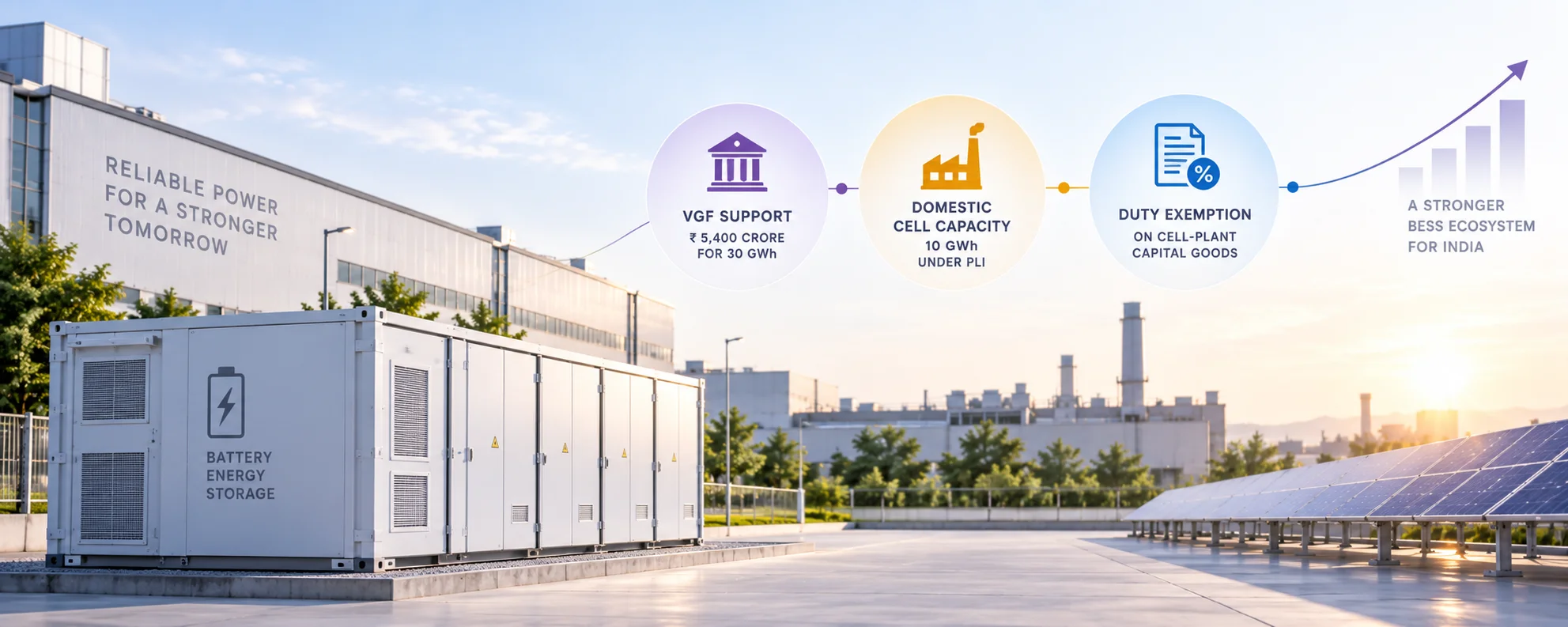
- The Rs 5,400 crore VGF tranche (June 2025) backs 30 GWh of new BESS, atop 13.2 GWh underway.
- ACC PLI earmarked 10 GWh of domestic cell capacity for grid storage; tender opened July 15, 2026.
- Budget 2026-27 extended the customs duty exemption on cell-plant capital goods to BESS cells.
- Landed cell costs hit about $55/kWh in H1 2026 after China cut export rebates.
- None of these levers cuts a factory’s price today; they compound over 2 to 3 years.
Why Are BESS Costs Called Falling in 2026 When Cell Prices Just Rose?
Three government levers announced between June 2025 and February 2026 lowered the policy-side cost of building BESS capacity in India. That is a different market from the battery cell commodity a system’s price tracks, and that commodity reversed course and rose through H1 2026.
The 2025 auction floor for standalone BESS tariffs fell to about Rs 148,000 per MW per month, a 35% drop, on the assumption that cell prices would keep declining. That assumption broke: China trimmed its export rebate from roughly 9% to 6% from April 1, 2026, lithium prices jumped over 100% in eight weeks, and IESA says up to 75% of the 2025 auction pipeline now faces viability risk. Gujarat’s regulator has approved tariffs as high as Rs 185,000 to 189,000 per MW per month. Check any quote against current cell pricing, not a 2025 benchmark.
What Do the VGF, PLI and Budget 2026-27 Levers Change for a Factory Buyer?
None of the three policies reduces a C&I factory’s purchase price on signing day. Each widens or de-risks the domestic supply chain a factory eventually buys from, which matters because India’s BESS market still leans on imported cells exposed to shocks like the one underway since early 2026.
The VGF tranche approved June 10, 2025 directs Rs 5,400 crore toward 30 GWh of storage bid through SECI and NTPC, mainly utility and DISCOM-scale, projected to draw about Rs 33,000 crore in investment. ACC PLI’s remaining 10 GWh, tendered from July 15, 2026, is earmarked for grid-scale storage rather than EV batteries, widening the domestic cell base a C&I integrator can eventually draw on. Budget 2026-27 extended the customs duty exemption on cell-manufacturing capital goods to cover BESS cells, cutting a manufacturer’s capex, not a finished container’s price.
BESS Cost Levers for Indian C&I Buyers in 2026
| Lever | Targets | Effect Today |
| VGF Tranche II, Rs 5,400 cr | Utility, DISCOM tenders | Indirect; deepens supply base |
| ACC PLI, 10 GWh tender | Domestic cell capacity | Indirect; cuts import dependence |
| Budget 2026-27 BCD exemption | Cell-plant capital goods | Indirect; lowers capex only |
| Global cell commodity cost | Landed cell price | Direct; up ~30% since Q1 2026 |
What Should a Factory Use for a BESS Payback Estimate Right Now?
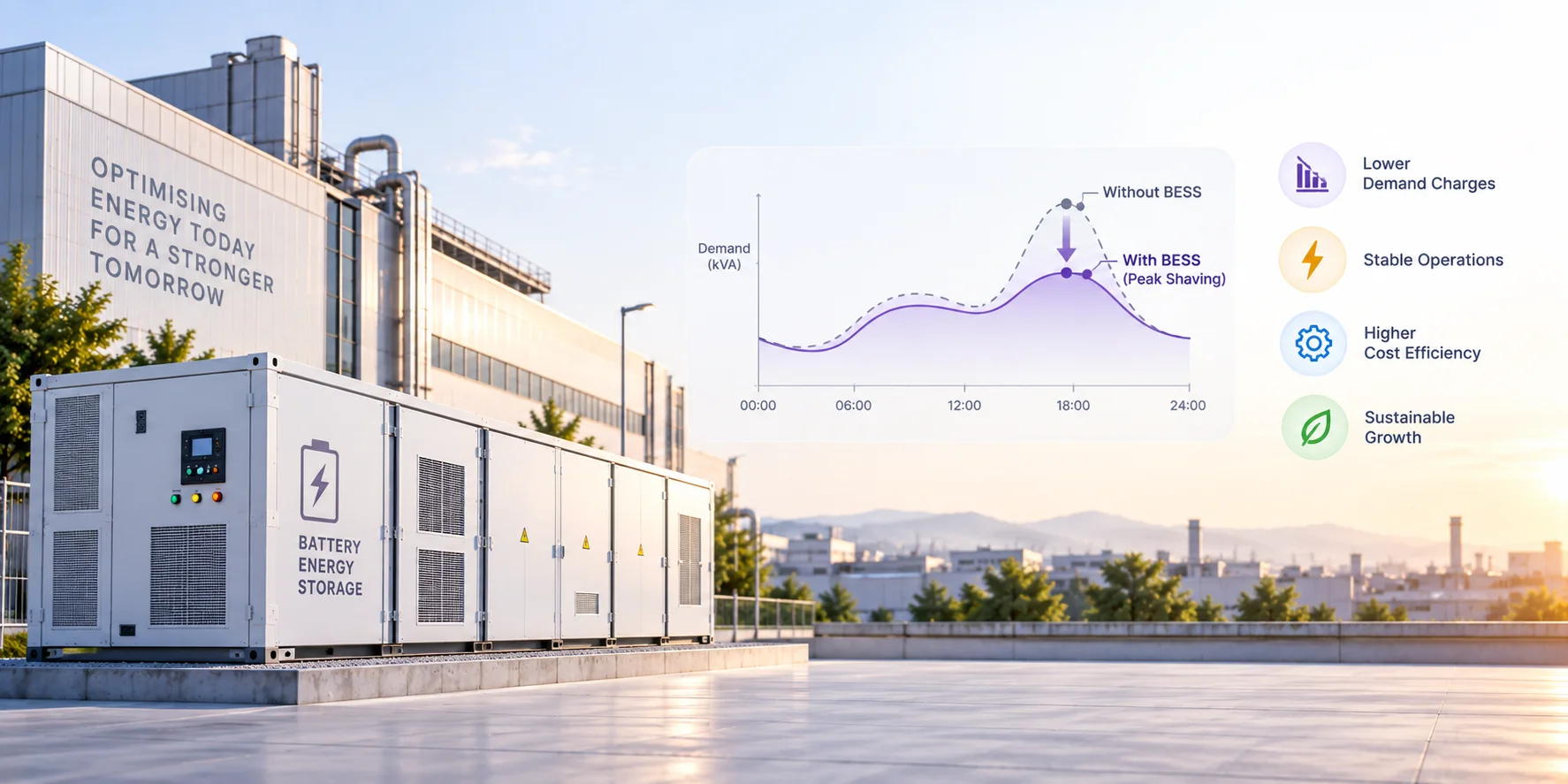
Size the case on current vendor quotes and a site-specific load profile, not a 2025 benchmark. Q Sine’s own C&I installations report a 20% to 40% reduction in demand charges and a 3- to 5 year payback for manufacturing facilities, a range that holds even with elevated cell costs because it is anchored to tariff structure, not capital cost alone.
A 1 MW, 2 MWh system sized for one or two peak-shaving events a day is the common starting point for a mid-size plant; see our guide on how BESS reduces operational costs in energy-intensive industries for the underlying mechanics. Most of the payback comes from avoided demand charges, not the policy levers above, which affect build cost, not savings once installed. Cell costs are volatile in mid-2026, so request pricing with a short validity window before sizing against last year’s numbers.
What is a realistic BESS payback period for an Indian factory in 2026?
Most C&I installations recover cost in 3 to 5 years, driven mainly by a 20% to 40% demand charge cut, not purchase price. This range has held through recent cell-cost swings because it tracks tariff structure.
The figure depends on contract demand and load profile; a site audit precedes sizing. See Q Sine’s Battery Energy Storage (BESS) Solutions for these configurations.
Does the Budget 2026-27 customs duty exemption lower BESS prices immediately?
No. It removes duty on capital goods for lithium-ion cell factories, including BESS cells, not finished systems. It lowers a manufacturer’s capex, reaching prices only as capacity comes online.
Do not expect a discount from it on a current quote. See Q Sine’s AC/DC Power Conversion System (PCS) for system detail.
Why did BESS costs rise in mid-2026 after years of decline?
China cut battery export rebates from 9% to 6% from April 1, 2026, and lithium, copper and aluminium prices climbed sharply, pushing landed cell costs to about $55/kWh.
IESA estimates up to 75% of the pipeline priced on the old assumption now faces viability risk.
References
1. Press Information Bureau, Ministry of Power. “Big Push to Battery Energy Storage: 30 GWh VGF Scheme Launched.” 10 Jun 2025. https://www.pib.gov.in/PressReleasePage.aspx?PRID=2135450
2. Press Information Bureau. “Highlights of Union Budget 2026-27.” 1 Feb 2026. https://www.pib.gov.in/PressReleasePage.aspx?PRID=2221455
3. Press Information Bureau, Ministry of Heavy Industries. RFP for 10 GWh ACC manufacturing capacity, Grid-Scale Stationary Storage, PLI ACC Scheme. 15 Jul 2026. https://www.pib.gov.in/PressReleasePage.aspx?PRID=2284916
4. Mercom India. “Underbidding in Battery Energy Storage Auctions Raises Questions Over Project Viability.” 4 Feb 2026. https://www.mercomindia.com/underbidding-in-battery-energy-storage-auctions-raises-questions-over-project-viability
5. Mercom India. “GERC Approves Tariffs for 1.665 GW/3.33 GWh Battery Storage Projects.” 2026. https://www.mercomindia.com/gerc-approves-tariffs-for-1-665-gw-3-33-gwh-battery-storage-projects
6. Construction World. “India Battery Storage Tariffs Seen Rising as Costs Squeeze Projects.” Jul 2026, citing IESA and SBI. https://www.constructionworld.in/energy-infrastructure/power-and-renewable-energy/india-battery-storage-tariffs-seen-rising-as-costs-squeeze-projects/94175
7. Q Sine Energy Solutions Pvt. Ltd. Battery Energy Storage (BESS) Solutions and AC/DC Power Conversion System (PCS) pages, qsine.co.in (first-party, live-verified).
Continue Reading
Get free access to this article and stay updated with Q Sine's latest insights on power quality and energy solutions. No spam, ever.
You're in!
Unlocking the full article now…
Your details are safe. We never share or sell your data.