
Understand the CEA requirements, measure at the right PCC, and use engineering data to keep your plant compliant and reliable.
Indian factories operating at 33 kV and above need to pay close attention to electrical power quality. Harmonic distortion, voltage unbalance and other power-quality issues can affect equipment performance, electrical losses and the reliability of operations.
The Central Electricity Authority (CEA) addresses harmonic control and monitoring through its Technical Standards for Connectivity to the Grid Regulations, 2007, as amended. Part IV covers grid-connectivity standards applicable to distribution systems and bulk consumers.
Q Sine Energy Solutions Pvt. Ltd., a Pune-based ISO 9001:2015-certified power-quality and energy-management manufacturer with 550+ installations across India, helps industrial facilities assess power-quality problems and identify appropriate solutions.
This guide explains the key CEA provisions, the role of IEEE 519, continuous monitoring, the Point of Common Coupling (PCC), and the potential role of Active Harmonic Filters (AHFs).
Key Takeaways
- CEA Part IV addresses power-quality requirements for distribution systems and bulk consumers.
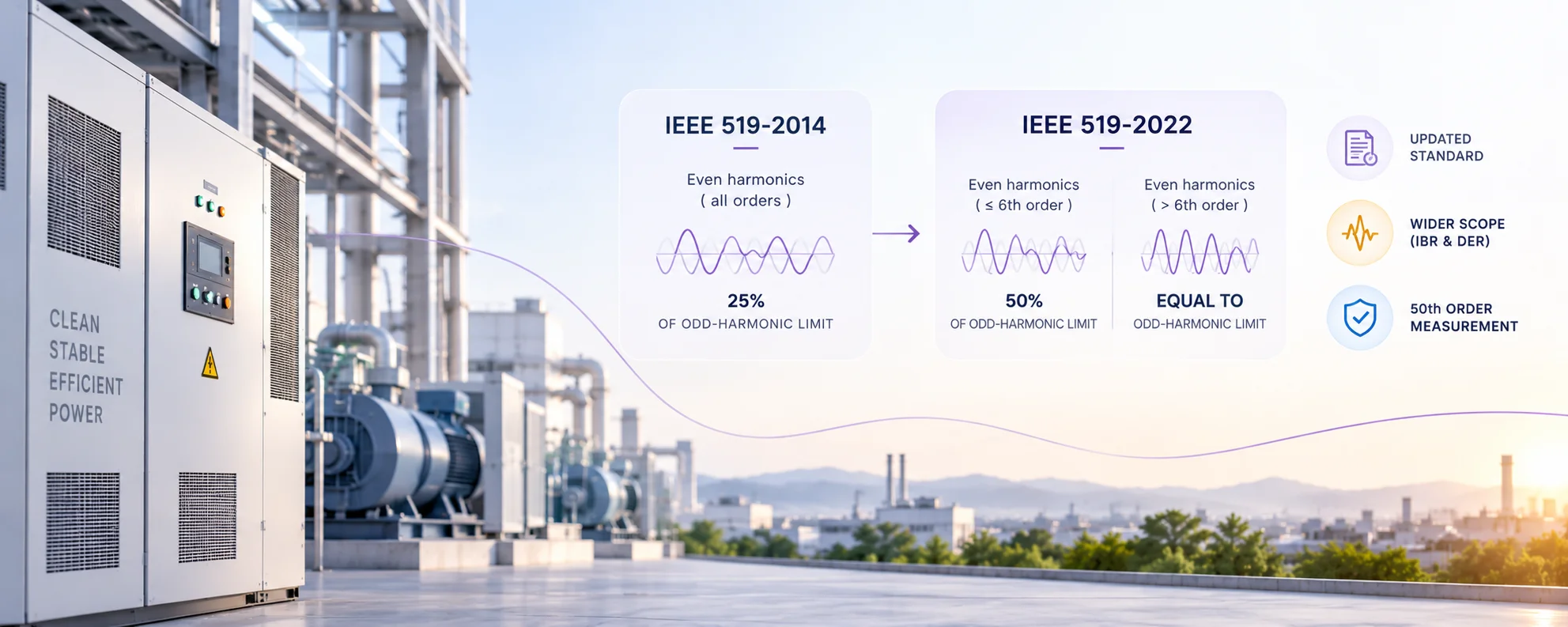
- The harmonic provisions reference IEEE 519-2014, as amended from time to time.
- Harmonic measurement and metering must be continuous using IEC 61000-4-30 Class A meters.
- The voltage-unbalance limit at 33 kV and above is 3.0%.
- The appropriate PCC and measurement methodology are essential for a meaningful assessment.
- A Power Quality Audit can help identify harmonic sources, quantify distortion and recommend corrective measures.
1. What Does CEA Require for Harmonic Control?
Part IV, clause 3 of the CEA Technical Standards for Connectivity to the Grid Regulations addresses voltage and current harmonics. Under the amended provisions, the limits for voltage harmonics, current-harmonic injection by bulk consumers, the PCC, measurement methods and related matters must be in accordance with IEEE 519-2014, as amended from time to time.
Harmonic compliance cannot be determined by applying one arbitrary THD threshold to every installation. The applicable assessment depends on the connection point, electrical system and the requirements of the referenced standard and regulatory framework.
Why a universal 5% THD limit is misleading
THD is the harmonic content relative to the fundamental component. Voltage THD and current distortion are different quantities. Compliance depends on the PCC, measurement configuration, operating conditions and applicable limits.
2. Who Is a Bulk Consumer?
Industrial facilities supplied at 33 kV or above are bulk consumers. Facilities with VFDs, induction furnaces, UPS systems, rectifiers, welding equipment and other nonlinear loads should pay particular attention to power quality. These loads can draw non-sinusoidal currents, which may contribute to voltage distortion and affect other equipment. A plant-level assessment should consider both the harmonic sources and performance at the relevant PCC.
Check the applicable regulatory definition, supply arrangement and connection agreement for your installation.
3. Continuous Harmonic Monitoring & Class A Meters
CEA Part IV requires continuous harmonic measurement and metering using IEC 61000-4-30 Class A meters. The provisions also cover data sharing, meter installation and periodicity as specified by the Electricity Regulatory Commission.
What to Monitor?
- Voltage THD & individual harmonics
- Harmonic currents vs. load
- Voltage unbalance
- Performance during operating conditions
- Relation between nonlinear loads and distortion
- Other parameters: sags, swells, flicker, interruptions
IEC measurement compliance and harmonic limits are separate. The correct measurement method and instrument capability must be established alongside the applicable limits.
4. Why Does the PCC Matter?
The Point of Common Coupling (PCC) is the interface between your installation and the wider electrical system. It is not automatically the billing meter.
The PCC should be identified from the plant’s electrical configuration and connection requirements. Measurements at different locations can give different results due to transformers, network impedance and load distribution.
A sound harmonic assessment should:
- Identify the relevant PCC and assessment criteria.
- Review the plant’s electrical configuration and operating conditions.
- Identify major harmonic-producing loads.
- Set measurement points for individual sources.
- Recommend suitable corrective measures.
5. How Can Factories Reduce Harmonics?
Start with measurement and analysis, then choose the right solution for your system.
- System modifications
- Passive filters
- Active Harmonic Filters (AHFs)
- Equipment-level improvements
How Active Harmonic Filters work
AHFs measure harmonic components and inject compensating currents to counteract them, reducing upstream harmonic currents and improving current-waveform quality. Actual performance depends on the spectrum, system impedance, load variation and installation configuration. Correct sizing and placement should be based on measured data and engineering analysis. Verify performance with post-installation measurements.
→ Explore Q Sine Active Harmonic Filter Specifications
6. Power Quality Audit
A Power Quality Audit can establish a baseline and prioritise corrective action. It may include:
- Single-line diagram review and distribution arrangement
- Identification of VFDs, furnaces, UPS and nonlinear loads
- Voltage harmonics, THD and harmonic currents
- Voltage unbalance and other power-quality parameters
- PCC and measurement locations
- Mitigation options and recommendations
Discuss Your Power Quality Audit
Get a detailed assessment and actionable recommendations for your plant.
Frequently Asked Questions
What is the CEA harmonic limit?
CEA Part IV references IEEE 519-2014 (as amended). Applicable limits depend on the standard and your connection arrangements.
Is continuous monitoring required?
Yes. IEC 61000-4-30 Class A meters are required, with data sharing and meter installation provisions.
Can an AHF make a factory compliant?
An AHF can help reduce harmonics, but compliance depends on capacity, placement, system conditions and the applicable assessment criteria.
Is a 5% voltage THD limit applicable?
No. A universal 5% threshold should not be assumed. The applicable limit and method must be established under the relevant framework.
Does the PCC always mean the billing meter?
No. It depends on your electrical configuration and connection arrangements.
How can a factory assess power quality?
A Power Quality Audit can identify harmonic sources, evaluate distortion and unbalance, and recommend corrective measures.
For factories supplied at 33 kV and above, Q Sine can help assess harmonic performance and evaluate suitable power-quality improvement measures based on your electrical system and operating conditions.
Q Sine Energy Solutions Pvt. Ltd.
Power-quality and energy-management solutions for a more efficient and reliable tomorrow.
Request a Technical Consultation →
References: CEA Technical Standards for Connectivity to the Grid Regulations, 2007 (as amended) | IEEE 519-2014 | IEC 61000-4-30
Q Sine Energy Solutions Pvt. Ltd. | Pune, India
Continue Reading
Get free access to this article and stay updated with Q Sine's latest insights on power quality and energy solutions. No spam, ever.
You're in!
Unlocking the full article now…
Your details are safe. We never share or sell your data.